Country Living in a Cariboo Valley

Homesteading in BC

  • How to Get Started
  • Vegetable Gardening
  • Preserving Food
  • Recipes
  • Homemade Wine Recipes
  • About Us
  • Work With Me
  • Shop
    • Vegetable Garden Planner Printable: Grow Your Best Garden Ever
    • Grow Enough Food for a Year
    • Delicious Dandelions: A Recipe Collection
    • Dirt to Dollars: Selling at the Farmers Market
    • 8 Pounds in 8 Weeks: Raising Chicks for the Dinner Table
    • Making Wild Wine
    • Build a Hanging Chicken Feeder
    • 15 Things to Know About Living in the Country

How to Plant Garlic Cloves – Growing Garlic Part 1

By Annie

Here are our best tips for how to plant garlic cloves in your vegetable garden!

Garlic is one of the easiest vegetables to grow in your garden or in containers. And it is wonderful to use in all kinds of cooking recipes, plus it’s also very healthy for us. 

Garlic doesn’t take up much room at all so you can either plant a bed of garlic cloves in a corner of your garden or tuck a dozen garlic plants in a pot and keep it on your deck.

Learn how to plant garlic cloves and hang garlic to cure
Our best tips for how to plant garlic cloves in your garden.

You can see we love to grow and harvest garlic! And because we live in a northern climate (Zone 3 Canada) we only grow a type of garlic called hardneck.

Hardneck garlic is a garlic variety that loves a cold winter; if you are in warm winter areas, grow softneck garlic instead, as softneck varieties are better in warmer climates.

How to Plant Garlic in the Fall

In our climate (cold winters) we plant our Garlic in the early Fall anywhere from around mid-September through to the middle of October. If you live in the South you plant in the early Spring.

Generally, you’ll want to avoid planting garlic where other garlic, onion, or any other member of the allium family has been planted recently.

This also includes plants like leeks, scallions, shallots, and chives. Rotating where garlic or other related plants are grown can help avoid allium pests or diseases.

Keep reading to see just how easy Garlic is to grow and then make sure you plant a few cloves!

How to Grow Garlic in a Raised Bed

Planting garlic cloves in a raised bed
Plant individual garlic cloves in a raised garden bed.

We plant garlic in our vegetable garden beds or in raised beds next door where we have lots of room. Add some good quality compost or well aged manure, blood meal, or fertilizer and dig it in well.

Rake the soil smooth and get ready for planting garlic cloves.

Planting Garlic Cloves

Here’s our Garlic Bed, ready for planting. We plant Garlic close together – you can see I have 4 beds separated by narrow walkways.

I take my box of keeper cloves (here’s how we decide which cloves to eat and which garlic cloves to use for planting) down to the garden.
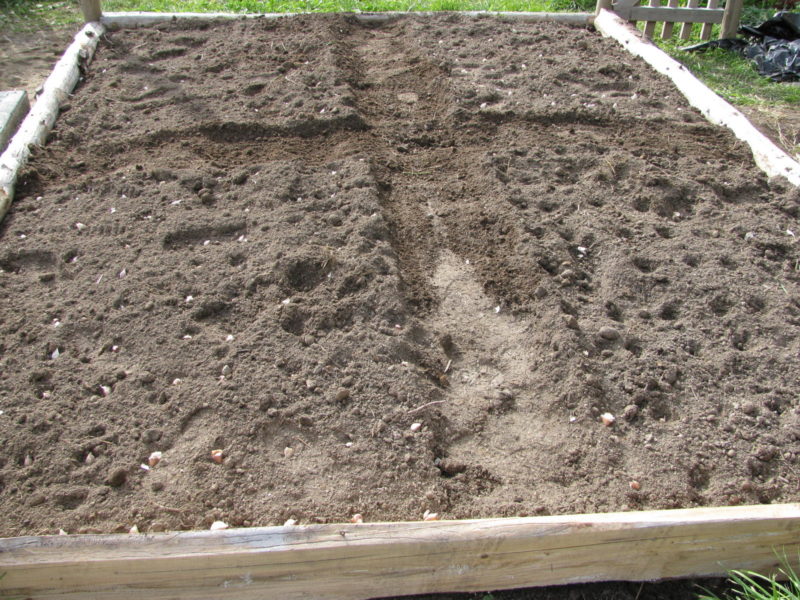
How to plant garlic cloves in a raised bed.
Plant Garlic cloves six inches apart in a pot or garden bed.

I plant the garlic cloves about 6 inches apart, with 8 inches between the rows. This ensures the garlic will get enough direct sunlight. Then, I push each of the cloves about 3 inches of depth below the soil surface.

 You can see the individual cloves in the picture above because I like to try and get the rows nice and straight, so I don’t push them down to seat them and put the soil on top of them until I am finished planting them all. I use the planted ones as markers for the rest of the cloves.

I was able to plant 288 cloves in that space! You can see it doesn’t take a lot of room to grow enough garlic for your family for the winter months.

Our 288 cloves is a LOT of garlic, but we love roasted garlic and we often have 2 whole heads of garlic between us at dinner time.

We also love making Bacon Wrapped Garlic Bites – so yummy as an appetizer!

If you cook the garlic, it is a lot milder than if you eat it raw and it’s so healthy for you! Lots of nutrients and flavor emerge when cooking.

After you plant garlic cloves, add mulch for winter.
After you plant garlic cloves, add mulch to protect them for winter.

How to Plant Garlic in Pots

If you don’t have room for a vegetable garden, you can easily plant garlic in pots, containers or grow bags. Grow some on your patio or balcony – just follow the same premise as for planting in a garden.

Plant your garlic six inches apart in good quality soil. These long rectangular flower pots work really well for growing garlic in a smaller space.

Since garlic doesn’t grow very deep, these pots are an ideal size.

How to Grow Garlic in a Flower Bed

Garlic plants are quite pretty and look nice when they are mixed in with perennial or annual flowers. If you’ve got a few empty spaces in your flower bed, plant some sprouting garlic cloves there!

Tuck three or four alongside any of your flowers or shrubs – they take hardly any room at all and will be easy to find when it’s time for harvesting garlic bulbs.

How to Plant Garlic Cloves
This guide explains exactly how to plant garlic cloves in a variety of locations!

How to Protect Garlic Cloves for Winter

It is a good idea to find a way to protect the garlic cloves for the winter months. Garlic is very hardy but if winter temperatures stay below zero, they really do need something to insulate them from the cold. 

How to Mulch Garlic

Mulch the whole bed with straw once the temperatures get down around freezing. Our temperatures are cold on Fall mornings and maybe close to freezing overnight.

We do not mulch right after planting. Wait until the temperatures go down; if you mulch too early the bed could be warmer than the garlic likes it.

Sometimes here, our garlic gets planted three weeks before we go out and cover with mulch.

adding mulch to cover a garden bed
Cover your garlic bed with straw or spent hay right before the snow flies.

I loosely add about three inches of straw on top of the bed. I don’t tamp it down at all; the rain and snow that is coming will do that. 

Once planted, all you have to do is weed it regularly during the growing season. One of the reasons I plant my Garlic tightly is that it reduces the weeds that come up.

So to get the Garlic in the ground and ready for Winter, it is just a matter of planting the cloves, covering them with soil, then covering them with a good layer of mulch later. You could use hay, straw, grass clippings or leaves.

During the Fall, your Garlic may start to grow and get a few inches of green leaf on them before Winter sets in. It’s OK…you don’t need to do anything to them – just wait for them to appear in Spring.

After planting garlic cloves, each clove will grow to become a garlic bulb.

In the Spring, you may need to remove some of the mulch, especially if you see garlic trying to poke through but not being able to.

If you see any yellow foliage, this is a good sign that the garlic needs more light.

Spring Growth for Garlic

In the Spring the Garlic bulbs will continue to grow. While the green leaves are growing above the soil, the Garlic bulb is growing below the soil. Water it every few days and keep any weeds out.

Garlic scapes growing from garlic plant.
The curled stems are Garlic scapes growing from the plant.

In early summer (think June and early July), you will see the Garlic Scape forming and coming out from the center of the growing stalk. Every Garlic plant will send out one Scape.

As they grow, they start to curl and they look great on the dinner plate cooked whole. Can you see the Scapes?

Garlic plants growing in a garden
Hardneck garlic sets out one scape per plant.

Before you know it, you’ll have lots of green shoots to harvest – just cut them off at the base of the Scape using a knife. I usually just snap them off, it’s much faster.

If you want nice big garlic heads, you MUST take the scapes off. This directs the energy into the bulb below ground, and it will then grow bigger.

Don’t just toss those Scapes onto your compost pile. They taste great!


How to Store Fresh Garlic

For garlic storage, you’ll want to find a place where the room temperature is on the cooler side and there’s good air circulation.

If you store garlic in the refrigerator, it may start to sprout in a couple of days.

Here are several different ways to preserve garlic in oil – including how to freeze garlic.

Now you know how to plant garlic cloves in the garden – plant some this Fall!

Garlic is very easy to grow and hardly takes any room at all. Every garden should have some garlic growing in it!

Freshly dug Garlic tastes nothing like the store bought Garlic you see in the produce section at the supermarket.

You can find good healthy Garlic by buying some at your local Farmer’s Market – ask if it was grown locally.

Just remember you need 1 clove per plant, so buy accordingly. There are roughly 6 – 8 cloves on one head of garlic. You can also buy hardneck garlic bulbs here online.


More Garlic Posts

  • Part 2 of the Garlic series is called “How to Make Pickled Garlic Scapes” 
  • Here’s how you can store garlic in olive oil – plus more ways to store garlic bulbs.
  • Wondering how to roast a garlic bulb? Find out here
  • This Feta Cheese Garlic Spread is a family favourite!


Published 2012, updated July 2022

Filed Under: Garlic, Garlic (4 Part Series), Grow Your Own Vegetables Tagged With: Garlic, Grow Vegetables

Growing Garlic – Part 3 How to Harvest and Cure Garlic

By Annie

Here’s the third part of our Growing Garlic series. Part 1 is an overview of growing Garlic. Part 2 covers harvesting the garlic scapes – which we turn into Pickled Garlic Scapes. Now we’re moving on to how to harvest and cure Garlic.

Your Garlic has now been growing all spring and summer. You’ve removed the Garlic Scape that is on each plant.

Right about now, you are probably quite curious as to when to get your garlic out of the ground. You want to see how big those bulbs are!

How to Harvest and Cure Garlic

 Garlic plants ready to be harvested from the garden.


How to Harvest Garlic

When the leaves of the Garlic are yellowing, it is time for harvesting. In the Cariboo which is Zone 3, that is usually the beginning of September.

As a sidenote:  Our garlic often gets yellowing tops early in the growing year.

This is because we often have very cool nighttime temperatures, so the garlic tops get a touch of frost early in the season. Your garlic tops may well be green all season long. 

We do not find that the yellowing tops affect the taste of the garlic at all. It’s just something that happens here because of those very cool temperatures.

Fresh harvested garlic bulbs with dirt on their roots.

Dig up a couple of plants, preferably from different parts of the garlic bed. Have the cloves formed? It’s time – you can dig up your plants.

It’s always better to harvest your garlic a bit early, rather than a bit late. You can tell if you harvested late if the cloves have started to pull away from the center stem.

You want to harvest when the cloves are still tight with a wrapper on them. This is the best stage for storing the longest.

You may find that there is dirt stuck in the roots, especially if your soil is moist. I rub the root end with my gloved hand and if the soil is a bit dry, it will crumble and fall out.

But if the soil is still quite wet, leave your garlic out in the air for an hour and let them dry a bit. This will make it easier to get the dirt out.

Try to NOT leave your garlic laying in the sun. You are better off to move it into a shaded area, even if there is still dirt on the roots.

harvested garlic hanging to cure in a breezeway


How to Cure Garlic

If the weather is supposed to stay warm, you can hang the bulbs outside (out of the weather). We hang them up in the breezeway down at the barn.

If your weather is supposed to be quite cool or even frosty, bring your Garlic inside instead or hang it where it will not get hit with frost.  I use to bundle the plants with baling twine. 

I’ve moved on to a heavier twine since then, as bundles with huge bulbs can actually be quite heavy. When I bundle them, I put all the largest bulbs together.

Garlic bulbs in a basket curing after being harvested


I may end up with 8 bundles of nice big heads and 4 bundles of smaller heads. That’s a lot of Garlic! I bundle them like this because it is faster.

Also, it’s easier for me to pick next year’s cloves (another post). I hang them in groups of 10, as I sell some and this makes it much easier to count up.

If you stab a Garlic head with the shovel when harvesting, be sure to place those ones of to the side. Use them up first.

Garlic that has been cut or scraped will NOT store well, and could introduce bacteria to other bulbs. Just keep those in the kitchen and start cooking!

garlic curing in a shallow basket 

After the bundles have hung for at least 10 days (maybe closer to 2 weeks), bring them into the house.

We keep our Garlic downstairs, hanging the bundles in my potting room. Or, you can trim off the stalks using your garden shears.


cured garlic stored in a open basket


Be sure to leave a 1 inch stem above the bulb. Then, cut the roots close to the base using some good kitchen scissors . Store the garlic bulbs in an open weave basket.

We don’t keep the Garlic in the Cold Room, as Garlic likes it a bit warmer than the 32 – 40 F temperature we keep the room at. 

When first hung, the aroma of Garlic fills the house –  what a wonderful smell.

buckwheat growing in a garden bed

Preparing a Garlic Bed for Planting

As soon as the Garlic is harvested and hung, we weed out the Garlic bed. It will only be a few weeks before this bed is planted again.

The earlier the bed is prepared, the better. If another layer of compost is needed, now is the time to add it. If we have time before planting, we will seed some Buckwheat in the bed to improve the soil for the coming year.

Buckwheat only takes about 5 weeks to grow and flower; this makes Buckwheat a fantastic soil builder. 


Now that you know how to harvest and cure garlic, let’s move on to replanting. I’ll show you how I choose which Garlic bulbs to replant for the following year. 

Here is the last installment  –  Growing Garlic – Part 4 (how to know which cloves to replant)


Filed Under: Garlic, Garlic (4 Part Series), Grow Your Own Vegetables Tagged With: Garlic, Grow Vegetables

Best Garlic Cloves for Planting – Growing Garlic – Part 4

By Annie

How to choose the best garlic cloves for planting – just follow these tips!

Here’s the fourth (and last) installment in the How to Plant Garlic series and this part focuses on how to choose the best garlic cloves for planting. The first article can be found here; Part 2 here; Part 3 here.

Here in Canada, we plant garlic (Allium sativum) in the Fall before the ground freezes. This allows the garlic cloves to settle in and even grow a few roots. Then when the cold weather comes, the cloves go dormant for the winter, then begin to grow early in the Spring.

Choosing the best cloves for planting goes a long way in growing large garlic bulbs! Here is information on hardneck garlic, plus sorting garlic bulbs and choosing cloves for replanting.

Best garlic cloves for planting on a counter
Here’s how to find the best garlic cloves for planting.

What are the Best Garlic Cloves for Planting?

There are two types of garlic that can be used for planting – hardneck garlic and softneck garlic. Here in Canada, we grow the hardneck varieties of garlic, because they do well with a cold period, meaning a cold winter.

Garlic Varieties:

Softneck varieties, such as Silverskins, grow well in southern climates, where they do much better than the hardneck type. The softneck type of garlic is not covered here, as we cannot grow that here.

Hardneck types that grow well in Canada and northern USA include:

  • Purple Stripe
  • Rocambole
  • Porcelains – Yugoslavian and Music
  • Chesnok Red
  • Fish Lake
  • Tibetan

Elephant garlic is actually not a type of garlic at all; it is one of the varieties of leeks!

Garlic cloves in a bowl ready for planting in the Fall
Save to your Pinterest board!


Curing Garlic

Read through the prior installments (see above) that will explain everything about harvesting and curing garlic. 

We begin sorting the best looking garlic bulbs when hanging them for curing. The nice big bulbs get hung together, while the smaller bulbs get hung together. These smaller bulbs will be eaten over the Winter (Spring & Summer too, because I plant so many heads).

The nice big bulbs are the ones set aside for seed for next years garlic harvest. We usually hang my garlic bulbs in groups of 10 using nylon rope. This makes for easier counting of the bundles and finding the total number of bulbs we brought to harvest. A looped rope goes around the stalk, tying up the leaves and stem. 


Garlic bulbs hanging to cure
Porcelain garlic hanging to cure in bundles of 10.


It’s important to plant the largest, nicest looking cloves, if you are trying to improve your garlic harvests.

Since we sell some bulbs, it’s in our best interest to ensure that as many of the bulbs as possible are big and beautiful! If you plant small, misshapen cloves you will get garlic heads full of small misshapen cloves.

It’s logical – if you are always trying to improve your harvests (and you are, aren’t you?) then always use your biggest and best. That way, you will get more of those biggest and best heads!


Choosing the Best Garlic Cloves for Planting

Once the garlic is cured, the stalks are cut from the bulbs, the roots are trimmed with garden shears and the bulbs are put into boxes. At this point, you can either start splitting the heads or just set the box aside for a couple of weeks. You will find it is easier to split the bulbs into cloves if the bulbs are drier.

Breaking Open Garlic Bulbs into Cloves

When you are ready to start busting the bulbs open, grab a couple of empty boxes and get started. Carefully open up all the heads and separate the individual cloves.


Garlic bulbs split and separated
The box on the right is full of cloves to be replanted in the garlic bed.


Put the nice big garlic cloves in one box – these are the bulbs that will be replanted in the garden. (The planting will take place around late September, in order for us to have lots of fresh Garlic next August.)

Smaller cloves go in another box for storage over the winter. These will end up in our kitchen where they will get roasted in the oven or put in tin foil on the barbecue.


A bowl of large garlic cloves separated for planting.
Nice healthy large garlic cloves set aside for planting.


I’ll use them when I make Bacon Garlic Bites or add them to my jars of Homemade Pickled Asparagus. Look at these beautiful garlic cloves – these are the ones that will be replanted for harvesting garlic next year.


Garlic cloves on dirt ready for planting. A measuring tape is there for spacing
Large garlic cloves ready for planting in the Fall.

You can get a good idea of the clove size in the photo above. That’s a standard sized tape measure – those cloves are quite large.

Ready for replanting? Head over to Growing Garlic Part 1, for all the planting information you need. Information in that post includes:

  • planting depth for each individual clove
  • fertilizing with blood meal
  • side-dress cloves with well composted manure and compost to add nitrogen to the soil
  • mulching with straw to keep weeds from growing
  • cutting off the flowering stalks of each garlic plant (here this happens in late June or early July)

Garlic Questions 

Is Store Bought Garlic Good for Planting?

It depends! Often, garlic bulbs bought at the grocery store have been sprayed with chemicals. It is very important to buy organic garlic bulbs from a reputable nursery. You can also find organic unsprayed bulbs at the farmers market.

Be sure to ask if the plants have been sprayed with chemicals. Organic sprays such as fish fertilizer is fine; this is a chemical free spray that helps with bulb growth.

What Type of Garlic is the Healthiest?

Any variety of garlic that is organically grown is a healthy garlic! Tip: You may find grocery store garlic has all of its roots shaved off. If the base of the bulb is completely root free and clean, it can be assumed that those bulbs have been sprayed.

The reason for the shaved base is that countries do not allow garlic to be imported with roots, as there is a greater chance of dirt coming in on those roots. This dirt may possible contaminate the soil in which they will now be planted.

Yugoslavian Porcelain garlic cloves in a bucket
Yugoslavian Porcelain garlic cloves for planting.

What is the Difference Between Seed Garlic and Eating Garlic?

There is no difference between seed and eating garlic. Usually, smaller bulbs and cloves are used for eating and the larger cloves are reserved for replanting.

What Month is Best to Plant Garlic?

The ideal time for planting garlic depends on the climate where you live. Here in Zone 3 (Canada) we plant garlic in late September or early October. We always aim to have garlic planted before the middle of October.

It is best if the cloves are planted early enough that they can form some root growth, but not too early so that the leaves start growing tall.

If the weather is unusual and top growth begins, your plants will still be fine. Just cover them with mulch once the cold weather starts.

How Do You Grow Garlic for Beginners?

This information can be found in Part 1 of this series – then continue reading the different articles in the series to get all the information, right from growing through harvesting and curing.

Garlic growing in a garden bed
A garlic patch in our garden.

I hope these posts all about growing garlic are a help to you. Garlic is easy to grow and takes up hardly any room at all. Even if you live in an apartment, you can easily plant 20 or 30 heads of garlic in a few pots or growing bags, so do it!

Backyard garlic growers love the strong fresh flavor of homegrown garlic! Plus, garlic is a very powerful natural antibiotic as well as an antioxidant.

Have you learned more about growing garlic from this series of posts? Feel free to share this article!


How to Grow Garlic Articles:

How to Plant Garlic – garlic bed preparation, spacing and garlic planting information

What to do with Garlic Scapes – and why you really do need to remove them

How to Harvest and Cure Garlic – from digging to hanging garlic for curing.


Find your best garlic cloves for planting – then get them in the soil this Fall for bulbs next August.


Want to find out which are The 5 Easiest Vegetables to Grow?

Available only to subscribers; join our Newsletter!


originally published October 2019; latest update January, 2023

Filed Under: Garlic, Garlic (4 Part Series), Grow Your Own Vegetables Tagged With: Garlic, Grow Vegetables

How to Make Pickled Garlic Scapes

By Annie

In this second installment on Growing your own Garlic, I’m going to share a fantastic Pickled Garlic Scapes recipe.

In the first post, I gave an overview about the process involved with growing Garlic. Garlic is one of the easiest garden vegetables to grow!

Here in the Cariboo, the Garlic Scapes come on hot and heavy in early summer around July. Since we have almost 300 garlic plants in the garden, we basically have almost 300 scapes!

Fresh garlic scapes in a bowl.
Here’s a Garlic Scape Pickle recipe you are going to love. Preserve garlic scapes to store them for year round use.

Every garlic plant sends one scape up and if you want the largest garlic bulbs possible, you have to cut the stems off.

The energy saved by not having the scape now goes into the bulb. This is a good thing. That makes the bulb grow BIGGER, which is what we want – the biggest, best bulbs we can grow.


Cooking Garlic Scapes

To cook the Scapes, just steam them for a few minutes if you like them still a bit crunchy or longer if you want to soften them. You can also lightly fry or grill them with a bit of sesame oil. Either way, they are delicious, with a strong garlic flavor.

We can only eat so many Scapes fresh with dinner so I looked around for something else to do with them. 

I found a recipe for pickling the scapes. I fiddled around with the ingredients and came up with this recipe.

You can print off the full Pickled Garlic Scapes recipe at the bottom of this post.


Pickled Garlic Scapes Recipe

  • 2 pounds garlic scapes
  • 1/4 cup canning salt (you can also use kosher salt in a pinch, but canning salt is better)
  • 2-1/2 cups white vinegar
  • 2-1/2 cups water
  • 1 tsp cayenne pepper, divided
  • <4 heads dill, divided
  • Pickling spice (optional)


  1. Trim ends off the garlic scapes. Combine salt, vinegar and water in a large saucepot. Bring to a boil.
  2. Pack scapes lengthwise into hot jars, leaving ¼ inch headspace. Add ¼ teaspoon cayenne pepper, and 1 head dill to each pint.
  3. Ladle hot brine over garlic scapes, leaving ¼ inch headspace. Remove air bubbles and adjust two-piece caps. Process pints and quarts 10 minutes in a boiling-water canner.

Yield: about four pints of liquid.

For some extra flavor, you can add ingredients like coriander seeds, red pepper flakes, black peppercorns, dill seed, bay leaves, garlic cloves, apple cider vinegar, or even some chili peppers.

Since we had fresh dill growing in the garden, I added that, along with a few very hot red and yellow peppers.

But first things first – I went down to the Garden and cut off all the Scapes I could find before retiring to the Porch to get started.

Fresh garlic scapes in a bowl.
Don’t these scapes look so green and beautiful?

I sat down with the bag of Scapes and first trimmed off just above the white bulb. Then I cut off the straight section of the Scape, leaving just the curled part. These went into separate bowls.

Trimmed garlic scapes in bowls.
You’ll want to trim them down so they fit in your jars.

I’m going to use fresh homegrown dill heads along with fresh homegrown hot peppers! They are going to add  great zingy taste to these Pickled Garlic Scapes.

Sterilizing Canning Jars

First, I need to get the water boiling as I need to sterilize the jars. Always sterilize your canning jars first when you are doing a boiling water bath!

sterilizing mason jars in boiling water.
All you need is a large pot and some boiling water to sterilize your jars.

Once the water is boiling (with enough water to fully cover the empty jars) I use tongs to submerse the jars and boil them for 10 minutes.

After cutting all the straight Scapes to a length to precisely fill the pint jars, I then cut the Curly Scapes into 2 or more pieces. These will go in separate jars.

At this point, I got the liquid mixture ready and put it on the stove to boil. I don’t like to do this too early in the process, as I find that it evaporates and I don’t have enough liquid to cover the Scapes in the jars.

Scapes in a colander in the sink.
As with any fresh produce, make sure you rinse them first.

Packing the Jars with Garlic Scapes for Canning

After the Scapes have had a good washing, I started packing them tightly into pint sized Mason jars.

Two mason jars fille with garlic scapes.
Don’t be afraid to really pack the scapes into the jars.

I cut the hot peppers into slivers, and included one of each color in each jar. These should really pack a punch, because those peppers are pretty hot.

tattler lids and rings.
I love my Tattler canning rings!


Using Tattler Lids and Seals

All this time, my canning seals and lids were sitting in scalding water waiting to be put on the jars. These are the Tattler lids and seals, which I love using.

I can easily recommend Tattler – using these lids and seals, you can get many many years of reuse from them. How nice not to have to buy new seals each year!

WIping down the rim of a jar.
Be sure to wipe down your jars before you finish up.

Adding Brine to Pickled Garlic Scapes

After filling the jars with Garlic Scapes, I poured the boiling liquid over top, leaving 1/4 inch of head space.

Before putting on the seal, I wipe each jar rim with a piece of clean paper towel. It’s important not to reuse the same portion of paper towel for the jars.

You don’t want to have lifted something off one jar, only to deposit it onto another. You want to make sure the rims are free of food and liquid.

Placing a rubber ring on the rim of a jar.
These rubber rings are super easy to use.

Time now to set a seal on the top of each jar. Just center the rubber seal on the rim. Once the top is put on, the seal will stay in place.

placing the plastic lid on top of the rubber ring.
Be sure everything is lined up nicely.

I add the the lid, then screw on the metal band.

Screwing on the Metal Band

Now here is where Tattler lids work differently than conventional canning seals and lids.

With the Tattler lids and seals, I need to screw the band on loosely and hold the lid in place with my finger while I finish tightening the band.

Then I need to turn the band BACK 1/4 inch. This is to allow the jars to vent while they are being processed.

Pickled garlic scapes and hot peppers in jars ready for home canning.
Look at how beautiful these scapes are all lined up!

Canning Pickled Garlic Scapes

Into the boiling hot water bath canner the jars go, and once the water is fully boiling, I set the timer for 15 minutes.

I need to add 5 minutes to the processing time, as I live at almost 3000 feet elevation. MAKE SURE you check your altitude before canning.

The elevation plays an important part of the canning process and you must be sure of how many minutes you need to process your food.

I often will have to remove water from the canner when I add the jars. You may need to as well, as the jar contents are heavier than the water.

You need enough water to cover the empty jars completely when sterilizing, but that may be too much water when you add the filled jars.

I keep a canning ladle and a large empty saucepan nearby so I can easily and safely remove some of the water while adding the filled jars.

Picking up a mason jar with tongs.
Using tongs to transfer your jars ensures you won’t get scalded or burnt.

Removing Jars from Water Bath Canner

After the 15 minutes are up, I use the canning tongs to remove the jars. I immediately tighten the metal bands on each jar.

Now I let the jars sit undisturbed for 24 hours. That means out of any drafts as well.

Then I wipe them down and put them away into the pantry or cold room. I can remove the metal bands now if I wish.

They serve no further purpose (sealed is sealed) and I can reuse the bands on other canning.

Right after I remove the band, I check the seal to ensure it is sealed. Just gently pick the jar up by the seal.

If the seal comes off, you can either put the jar into the fridge and use the contents within a week. You can also reprocess the jar in the boiling water bath.

Properly canned, these Pickled Garlic Scapes will last for years in your pantry.


Safe Home Canning

I have been canning food for well over 20 years. Canning is safe to do and safe to feed your family, but do NOT cut corners.

I cannot stress that enough. Do not go to all the trouble of preserving if you are not going to follow exact instructions.

They are in place for a reason – if you do not can safely and accurately, you run the risk of feeding your family spoiled food. This can cause very severe illness and even death. You can’t always smell the bacteria, so don’t rely on your nose!

Part 3 of Grow Garlic can be found here.

Now, start canning and filling your cupboard shelves with your own, freshly grown food. Water bath canning is easy, safe and can save you a lot of money. Do the work now while the harvest is here and you will enjoy that harvest right over Winter!


Other Uses for Garlic Scapes

Use your scapes to make a garlic scape pesto, which is great on burgers and sandwiches. You can also top salads with scapes for an aromatic garlic-y addition, or toss them in with your next stir fry.


Looking for more Pickle Recipes?

  • How about trying some Homemade Pickled Beets?
  • Pickled Asparagus Spears are great on a pickle plate or to add to a Caesar or Bloody Mary!
  • If you’ve got extra eggs on hand, try this Pickled Egg recipe.
  • Websites such as Simply Canning and Bernardin are great resources if you are new to canning.
Pickled Garlic Scapes with pickling spice being added to canning jars
Pickled Garlic Scapes are easy to make and have a wonderful zingy taste. Here’s a recipe to make your own Pickled Scapes at home.


Pickled Garlic Scapes in Canning Jars on wood counter

Pickled Garlic Scapes

Yield: 8 pints
Prep Time: 25 minutes
Cook Time: 15 minutes
Total Time: 40 minutes

These easy Pickled Garlic Scapes are a great way to preserve these short lived scapes.

Ingredients

  • 2 pounds garlic scapes
  • 1/4 cup canning salt
  • 2-1/2 cups vinegar
  • 2-1/2 cups water
  • 1 tsp cayenne pepper, divided
  • 4 heads dill, divided
  • Pickling spice (optional)

Instructions

  1. Fill water bath canner with water and turn on high heat.
  2. Add clean pint size mason jars to the water in the canner.
  3. Once boiling, set timer for 15 minutes to sterilize jars.
  4. Trim ends off the garlic scapes.
  5. Combine salt, vinegar and water in a large saucepot. Bring to a boil.
  6. Pack scapes lengthwise into hot jars, leaving ¼ inch headspace. Add ¼ teaspoon cayenne pepper, and 1 head dill to each pint.
  7. Ladle hot brine over garlic scapes, leaving ¼ inch headspace. Remove air bubbles and adjust two-piece caps.
  8. Process pints and quarts 10 minutes (depending on altitude) in a boiling-water canner.
  9. Remove jars when time is up, set on a thick towel on the counter out of the way and in a draft free place.
  10. Leave jars to seal and cool for 24 hours, before wiping jars and storing in your cupboard.

Notes

You can also use kosher salt in a pinch, but canning salt is better.

Nutrition Information:
Yield: 64 Serving Size: 1
Amount Per Serving: Calories: 6Total Fat: 0gSaturated Fat: 0gTrans Fat: 0gUnsaturated Fat: 0gCholesterol: 0mgSodium: 445mgCarbohydrates: 1gFiber: 0gSugar: 0gProtein: 0g

Did you make this recipe?

Please leave a comment on the blog or share a photo on Pinterest

© Annie
Cuisine: American / Category: Canning


Fresh garlic scapes in a bowl.
Here’s a Garlic Scape Pickle recipe you are going to love. Preserve garlic scapes to store them for year round use.


originally published 2011; last updated July 2022

Filed Under: Canning, Garlic, Garlic (4 Part Series), Grow Your Own Vegetables Tagged With: Canning, Garlic, Grow Vegetables, preserving, Tattler

Make A Personalized Seed Starting Schedule

By Annie

At this time of year, my mind starts to fixate on seeds for the upcoming garden. Not that I can do anything about it; it is way too early for me to get any seedlings started indoors.

I do, however, check my seed starting schedule to see when I can get those first seeds started.


Seed starting schedule hand written in a lined book.


Sometimes I will feed my urge and start some perennial flower seeds and that helps a bit. But really it is veggie seeds I want to start planting. I am always itching to get some salad greens going.


The very best posts for 2017 from Country Living in a Cariboo Valley #homesteading #farm #selfsufficiency


But it’s definitely still winter here in the Cariboo. We usually have several feet of snow – the garden soil is resting for a while longer. That snow acts as a great insulator. 


Make your own zone specific seed starting schedule.


Your Elevation is Important to your Seed Starting Schedule

A really important factor in when you should be starting your seedlings is your elevation. Most people do not take into consideration the importance of the elevation you are gardening at.

Higher elevations can mean later harvest dates and the possibility of earlier frosts.

We’re at 2800 feet elevation here and often can’t even get into the garden until the early weeks of May. In drier years, we might be able to get root crops planted in late April.

Root crops include vegetables like potatoes, beets, carrots, turnips…the list goes on. These root crops can go in the garden just as soon as you can work the soil.

It doesn’t matter if the weather turns cold after they are planted, they will be fine.


If you’re not sure of your elevation, you won’t really know how long your growing season is.


You need to know the length of your growing season. Talk to gardening neighbors and ask for gardening tips.

You can learn a lot about local weather conditions and the micro climates in your garden.

If you are new to gardening in the North, you may not know how difficult it can be to grown certain kinds of vegetables.

I had no idea before we moved here that it is VERY hard for us to grow corn outside of the greenhouse. Some veggies are definitely more heat loving than others.

Getting these heat lovers (peppers, tomatoes, squash) started too soon can mean leggy plants or even flower buds forming in the house.

Colder winter climates mean later starts in the garden and you have to adjust accordingly. Don’t forget to take cool nights into consideration.

If you have extreme temperature swings (night and day) take extra precautions if you need to.

Remay cloth or a small hoop house may be a great help in protecting those heat loving vegetables. They can extend the growing season by at least one month on either end.


The greenhouse in early Spring.


If you are thinking of something larger, read about how to build a greenhouse for under $200.00 like we did.

The flip side of living here is that vegetables seem to grow a lot faster here than they did down on the BC Coast.

Even though we start later than a lot of other gardeners, most of our late maturing vegetables can still be harvested before the end of September.


My Seed Starting Schedule


Create your own zone specific seed starting calendar. Know when to seed and when to harvest. #garden #gardeningideas #seed #seedschedule


Not long after we moved here in 2006, I sat down with all my seed packages and figured out a seed starting schedule.

This is specific for my area (Zone 3 Canada) and I use a transplant date of June 1 (the date by which I can actually move the seedlings into my Garden).

Plants like peppers and tomatoes can go into the greenhouse usually by the end of the first week of June. Overnight temperatures here can be a killer, even when plants are under cover!

When I wrote this up, I couldn’t find a plant chart anywhere with my Garden Zone. Use my seed starting schedule and make it your own.

Vary the dates according to your gardening zone. Remember to check your elevation and change the dates accordingly.

If you are at a higher elevation, you may need to stretch the dates out another week.


create a personalized seed starting schedule for your garden.


The Headings for my personalized seed starting schedule:

I’ve got the Indoor Start Date, the Days to Maturity and the Dates of Maturity, using the June 1 transplanting date.

I also have a column named Direct Seed.

This is for vegetables that I can just direct seed right into the garden and don’t need to bother starting in the house.

You may think that is an unnecessary column, but it helps me when it comes to seed ordering time.

I can look at the vegetables that fall into that category, check them against my supply on hand and figure out easily if I need to buy more seed.


A garden specific seed starting schedule for your garden.


See the numbers in parentheses after the Vegetable type?

Those were the number of seed packages that I had on hand the year I made up the list, so just ignore them.

As you can see by looking down the Indoor Start Date, the earliest date to start anything is March 26!

I will start with seeding Cabbages and Peppers and won’t even move on to seeding any Tomatoes until mid-April!

This seed starting schedule helps me keep on track and not plant too early (or too late).

These dates may seem very late to you, but this is what works here for us at 2850 feet elevation and a Zone 3 garden.


Personalized seed starting schedule for YOUR garden!


The Downside of Starting Seeds Too Early:

If you live in the Cariboo (or northern US), don’t start your seeds too early. It is an easy mistake to make!

Make a specific seed starting schedule for your own garden and then follow it.

It is heartbreaking to end up with very leggy vegetable seedings. They tend to break very easily when you have to move them from the house out to the garden.

You can transplant them into larger containers if you need to. Most plants like growing root bound and then being transplanted into extra room to put on more growth.

We usually start so many seeds indoors I simply don’t have room to keep that many big pots in the house.


Your garden specific personalized seed starting schedule makes sowing seeds easy.


Tomatoes are always transplanted, at least once but sometimes twice. They really benefit from being moved up into a larger pot.

I try to start in small containers and then transplant them as they grow. It is more work for me, but the plants respond better by getting root bound first and then transplanted.

Here’s how to transplant tomatoes.


Personalized seeding schedule for your garden.


I start a lot of my seeds under lights down in our basement and then move them up to my living room when they get large enough to not need the lights.

This helps make room for even more seedlings downstairs.

If the weather is warm enough, I then move them out to the greenhouse, where I can also start other seeds.

Our greenhouse is unheated and so it depends on how cool the nights are, as to whether I can move and start seedlings out there.


Filed Under: Grow Your Own Vegetables, Starting Seeds Tagged With: Grow Vegetables, seed starting

  • 1
  • 2
  • Next Page »

Connect With Us!

  • Email
  • Facebook
  • Instagram
  • Pinterest
  • Twitter

Search this site

Generic selectors
Exact matches only
Search in title
Search in content
Post Type Selectors
Search in posts
Search in pages

Our Most Popular Posts

Garlic cloves in oil

How to Preserve Garlic in Oil – and Other Ways to Store Garlic

a open jar of pickled brussel sprouts on a counter

Easy Pickled Brussels Sprouts Recipe (Water Bath Canning)

Privacy Policy

Read about our Privacy Policy

Disclosure

Please note that some of this site’s links are affiliate links, and CountryLivinginaCaribooValley.com is a participant in the Amazon Services LLC Associates Program, an affiliate advertising program designed to provide a means for us to earn fees by linking to Amazon.com and affiliated sites. At NO ADDITIONAL COST TO YOU, I will earn a small commission, if you purchase them. I recommend them as they are good products.

Theme Design By Studio Mommy · Copyright © 2026