Country Living in a Cariboo Valley

Homesteading in BC

  • How to Get Started
  • Vegetable Gardening
  • Preserving Food
  • Recipes
  • Homemade Wine Recipes
  • About Us
  • Work With Me
  • Shop
    • Vegetable Garden Planner Printable: Grow Your Best Garden Ever
    • Grow Enough Food for a Year
    • Delicious Dandelions: A Recipe Collection
    • Dirt to Dollars: Selling at the Farmers Market
    • 8 Pounds in 8 Weeks: Raising Chicks for the Dinner Table
    • Making Wild Wine
    • Build a Hanging Chicken Feeder
    • 15 Things to Know About Living in the Country

How to Use a Pressure Canner

By Annie

Once you learn how to use a pressure canner, you’ll be amazed at the kinds of meals you can set aside in your food pantry.

Learning how to use a pressure canner can be a nerve wracking experience. But, once you get used to it, you will become much more comfortable with using your canner.

I’ve been using a pressure canner for years. And yes, I was really nervous when I was learning. And that’s OK! 

How to Use a Pressure Canner

If you’ve never canned a single thing in your life, I would really suggest you start by learning how to can using a water bath canner.

It is the easiest way to learn how to safely can food at home. And there are a lot of different foods like fruits, jams, jelly, and pickles that can safely be water bath canned.

Although some foods can be safely canned in a water bath canner, other foods NEED to be canned using a pressure canner.

These include food like any kind of meat or fish. Soups, stews and chili are just some of the foods that need to be pressure canned. 

Learning how to use a pressure canner properly will give you confidence with your food safety.
We use our pressure canner outside on a propane burner.

Canning Food Safely

Food safety is so important to me and it should be important to you too. You never want to open a jar of home canned food and have to wonder if it is good to eat.

Sometimes you can see signs of spoilage, but sometimes you cannot. You don’t want to feed anyone food that has not been safely canned.

These concerns have made me very particular about how I go about canning and storing food.

I take ZERO shortcuts, I make sure my equipment is clean and my canning lids and seals are in good shape.

jars filled with salmon ready to be canned
We try to pressure can jars of smoked salmon and trout every year.

When I look at my stocked pantry, filled with home canned foods like lamb stew, green beans, carrots, beets, pickles, jams, jellies and a lot of other items, I get such a sense of pleasure.

A week's worth of home canned food ready to be put into the cupboard.
A week’s worth of home canned food. Shopping is easier when you only have to go to your pantry.

Pleasure because I know exactly what is (and what isn’t) in my home canned food. A true sense of satisfaction because I love the look of all those pretty jars on the shelf.

And I know I can feed my family good healthy food that is safe to eat.

Are you as careful as I am when it comes to preserving food? If not, you should be!

Never take a chance – it is not worth it if someone you love gets sick, or even worse, dies from incorrectly canned food tainted by botulism, which is more likely with low-acid foods (like mushrooms, onions, chicken, potatoes, etc). 

Water bath canning is a fine option for foods that are higher in acid (think tomatoes, pickles, fruit), but any pressure-canning recipe that features a low acid food will be better off in a pressure canner.

You can get more information about the differences from sources like the National Center for Home Food Preservation.

What are the Different Types of Pressure Canners?

Pressure Canners – Weighted Gauge or Dial Gauge

There are two different types of gauge canners to choose from. One is a weighted pressure canner and the other is a gauged pressure canner.

Each have their own set of pros and cons. Below are a few key differences between each to help you determine which pressure canner you’d like to use.

How to Use a Pressure Canner with a Weighted Gauge

A weighted pressure canner on a propane burner
This is a weighted gauge pressure canner. The weight will jiggle when the canner is under pressure.

The weighted gauge pressure canner can release any pressure that goes above your desired pressure level. The downside is that a weighted gauge cannot measure the pressure.

It simply keeps track of what level you want the pressure at and keeps it at that pressure.

A weighted gauge will fit over the air vent tube and jiggle to release the steam as the pressure starts to go above your desired pressure level.

You need some way to monitor pressure because canning at too low of pressure can result in food that won’t be canned well enough for long term storage.

Key Features of the Weighted Gauge Canner

  • Regulates the pressure inside your canner.
  • The open vent is the same one that fits the pressure regulator.
  • Continuously allows air to be released to maintain pressure.
  • Doesn’t need you to check for accuracy, in fact, you can’t check it.
  • Not as flexible with adjustments as the dial gauge pressure canner.

Here’s a good quality weighted gauge pressure canner – over 1400 reviews for you to research.

How to Use a Dial Gauge Canner

A dial gauge pressure canner
This is a dial gauge pressure canner. You can keep an eye on the gauge to check the pressure.

The dial gauge pressure canner lid has a dial that allows you to monitor, measure, and change the pressure during the process of pressure canning. This looks similar to a knob you’d see on your kitchen stove.

The dial gauge has a needle that shows you where the temperature is during the process of canning.

A dial gauge pressure canner will allow you to measure the pressure during the process of pressure canning.

This is an excellent option for someone starting off with pressure canning because they can see the pressure and have a bit more control as they learn the process of pressure canning.

Key Features of the Dial Gauge Pressure Canner

  • Features the pressure inside, displays this for you to see during the processing time.
  • Must be checked regularly to ensure accurate pressure is maintained.
  • More flexibility than a weighted gauge.
  • Has dead weight to close or open vent for pressurizing.

Here’s a good quality dial gauge pressure canner for the price. Over 8,000 reviews – go over and take a look!

a venting pressure canner on a stove

If you’ve always wondered how to preserve your own food, this guide has all the tips you need!

The Process of Pressure Canning

The purpose of knowing how to properly use this canner is so that you’re able to feel confident about serving your family food that’s been stored properly.

Pressure canning helps preserve your harvest so that it has a longer shelf life for storage in your pantry or other food storage space.

Here are some tips and must-know parts of pressure canning to help guide you in canning and storing food properly. 

Clean the pressure canner and make sure it’s working properly. Make sure all of the vent pipes are clear and free of mineral build-up.

Check the manufacturer’s directions on appropriate burners, but generally speaking, you’ll want to make sure your gas range doesn’t go over 12,000 BTUs.

Place your cleaned pressure canner in the center of the burner. Put the rack and hot water inside your pressure canner.

If you don’t have an exact measurement for how much hot water for the food you’re about to can, just make sure it’s 2-3 inches high in the canner.

Some foods, like smoked fish, require more water. This is because meat and fish need to be canned for 100 minutes and you don’t want the canner to run out of water.

Be sure to check with USDA requirements on how much water is needed for the food you’re planning to can before starting.

  • For hot packed foods you’ll want to bring the water inside your pressure canner to 180 degrees Fahrenheit.
  • For cold packed foods you’ll need to bring the water inside your pressure canner to about 140 degrees Fahrenheit.


Loading the Canner

Get your canning jars ready with the food inside, lids and bands secured.

Take a look at this post which shows you what to do to prepare your jars for canning.

This will be what we refer to as “fitted jars” in the next step of the pressure canning process.

You’ll fill the jars with food leaving about half to one-inch headspace between the food and the lid of the canning jar. Screw the lids on tight.

Next, you’ll place your fitted jars on the jar rack in your pressure canner. You should use a jar lifter during this process and keep the jar lifter securely positioned below the ring band of the lid.

Always keep the jar upright to avoid food or liquid spillage during the process.

Start to steam your fitted cans for ten minutes. You’ll turn the heat on high, if not already on high, and leave the vent pipe or petcock open.

When you see steam beginning to escape from the pressure canner, you’ll want to start the timer for 10 minutes.

You’ll need to put the weighted gauge on or close the petcock, depending on which pressure canner you’re using.

Always wear a heavy oven glove when you do this! Protect yourself from the steam coming from the canner.

  • Adding Weights to the Pressure Canner
    • Read the recipe and instructions for canning this particular food to know which measurement of weights you’ll place on your regulator.


Building Pressure in the Canner

The pressure canner will begin to pressurize now, once it reaches the appropriate pressure level, you’ll begin timing based on how long the food needs to be pressure canned for.

If you’re using a weighted gauge you’ll know when the pressure has reached optimal pressure when the weighted gauge starts to jiggle or rock.

Pay close attention to keeping the pressure at the recommended level for the food as per USDA guidelines to ensure safe food storage.

Once the pressure canning process is complete, it’s time to safely remove the pressure canner from the heat. Allow the pressure canner to cool naturally.

Forced cooling may cause your food to spoil thus ruining food and having to start the entire process over.

Note: It usually takes longer for the pressure canner to cool down than beginners seem to think! Just let it cool on its own, at least one hour. 

Older canners will need you to be more careful about removing the weighted gauge once the pressure canner is cooled, as some steam may still roll out.

Newer pressure canners will have a lid lock that unlocks once the pressure canner is cool enough to open.

Removing Jars from the Canner

Use a jar lifter to remove each of the cans from your pressure canner one by one, being mindful to keep your jars upright to avoid food spillage.

Place the jars on a towel or cooling rack with at least one inch spacing between each jar. Don’t crowd your jars!

Now is the time to leave the canning jars alone for 24 hours so that they can cool completely. Once the jars are cooled completely, you can handle the process of making sure the bands are removed and the middle of the lid is pushed down to fully seal your food.

If you find that some of the cans wouldn’t seal properly, place them aside or in your fridge and use these cans first.

It’s best to be safe than sorry when it comes to pressure canning the food you’ll be eating and serving to your family!

Most Common Pressure Canning Mistakes

There are some common pressure canning mistakes that people make during their first time with this process.

As a means to help you have a successful batch of pressure canned food, I wanted to give you a list of common mistakes to help you avoid making them during the process of pressure canning:

  • Not adjusting the pressure canner timer and pressure due to higher altitude. If you live more than 1000 feet above sea level, you’ll need to adjust the pressure and add more time to the process. Check your manual.
  • Overfilling the jars. You need to leave about half to one-inch space in the jars between the top of your food and the rim of the jar.
  • Using cracked or chipped canning jars. Inspect your canning jars before use for any minor or major damages. Only used canning jars that are free of cracks and chips.
  • Not using enough water in the water bath. The jars must have at least 1-2 inches of water surrounding them inside the pressure canner to ensure safe food canning.
  • Not letting the pressure canner cool naturally. It’s important you leave the pressure canner alone until it naturally depressurizes before doing anything with your cans that are inside.
learning how to use a pressure canner
Check out this step by step guide on how to use different kinds of pressure canners!

FAQs about Pressure Canning

Can You Use a Pressure Canner on a Glass Top Stove?

Sometimes. It depends on the make and model of your stove.

We do our pressure canning on a propane burner on our front porch. We have a glass topped stove and some glass stoves are not equipped to handle a pressure canner.

Since we have the ability to do our canning outdoors, we  just don’t want to take the chance using the stove.

Check your stove manual and if in doubt, use one of these propane burners instead. 

Bonus: Canning outdoors keeps your kitchen and house much cooler in the summer.

How Much Water to put in a Pressure Canner?

 You need to have at least 2 inches of water in your pressure canner. The one thing you do NOT want to happen is to run your pressure canner dry!

So put in extra – as an example when we can meat (remember, 100 minutes at 15 lb pressure here for us), we add 4 1/2 quarts of water to the canner.

Where to Buy a Pressure Canner?

You can buy a pressure canner on Amazon. Take a look at the number of reviews and take the time to read through some of the reviews.

The best pressure canner companies are:

  • All American pressure canners
  • Mirro pressure canners
  • Presto pressure canners

These are all good quality pressure canning brands.

Is a Pressure Cooker the same as a Pressure Canner?

No, a pressure canner and a pressure cooker are NOT the same thing. However, you can use a pressure canner as a pressure cooker.

You can NOT safely use a pressure cooker as a pressure canner.

Food we Can Using a Pressure Canner

  • Read about how I home can salmon to learn the process I use for using the pressure canner.
  • If you want to learn how to can food using a water bath canner, check out this post on canning cherries.
  • After reading these posts, think seriously about buying a canning book. The Ball Complete Book of Home Preserving is a really good resource.
Filling jars with lamb stew to be canned
Canning lamb stew. All meat needs to be pressure canned.

If you are going to can anything with meat in it, it MUST be pressure canned.

I’ve had my pressure canner for over 10 years and it still works great. I’m replacing the gasket this year and ordered it through Amazon.

So, if you’re new to the idea of preserving your own food, don’t be afraid. If I can do it, you can too. Just remember to always think of Safety First!

Now that you know how to use a pressure canner, it’s time to get started canning!

By the end of this year’s harvest, you will be able to put your own home canned jars of great food in your pantry. 

More Articles about Food Preservation:

  • Want a list of every article about how to preserve food that is on the site? 
  • Want to find out how I go shopping all winter long without even leaving my house?
  • Here are the 4 Ways we Store and Preserve Food.
  • Learn the many ways to store home canned food here.

Are you new to the idea of self sufficiency? Here is how to get started providing for your family by growing your own food and raising some of your own meat!


originally published August 2017; last updated August 2022

Filed Under: Canning

Canning Inventory Checklist – A Free Printable

By Annie

I had to go down to the cold room yesterday to put away a few more filled canning jars. And I realized it is a mess down there! I really needed some kind of printable canning inventory checklist to keep track of our food storage.

I needed a canning list that I can keep in the kitchen and just make a new note every time we can some more food for the pantry. 


dozens of home canned mason jars of food, and eggs, garlic and onions on a stove top


Free Printable Canning Inventory Checklist

I made something yesterday that will help me so much with knowing exactly what is in my canning room. 

And I want to tell you about it so you can download your own free printable canning checklist!


Ever year, we can jar after jar of fruits, vegetables and fish including:

  • pickles
  • jams
  • jellies
  • sauerkraut
  • berries
  • tomato sauce
  • all kinds of vegetables
  • salsa

and other food as well. So it doesn’t take long to forget exactly how many jars of beans I still have on hand. 


getting mason jars of salmon ready to go in pressure canner


Pantry Organization

I love it when my food storage is well organized. I have my cases of empty mason jars stacked in quarts, pints and half pints.

One stack is quarts, another pints, and so on. Usually I keep the boxes of empty jars on one side of the (very small) room.

This helps me know, at a glance, how many empty jars I have on hand. Do I need to buy more? I can tell with one look.

On the other side of the room we have strong shelves along the length of the wall.

On these shelves are the boxes of full jars, labelled on the outside. I usually just tape a labelled paper on the outside with the contents of the boxes.

That way, it makes it easy to reuse the same boxes, just rip of the label and put a new one on when needed.

So I do start out organized. It just never stays that way.

Over the course of the year, it always ends up that full jars get mixed in with empty jars.

And I really needed a better system to keep track of my jar totals.

This canning inventory chart is really going to help me organize our food storage better. And I’d love for it to help you too!


Sign up for our newsletter and

download your own copy of my printable

Canning Inventory Checklist


printed Canning checklist to keep track of home canned food


How I can Benefit from my Canning Checklist


Every time I finish a pressure canning session, I will just add it right away to the inventory list. 

And when I do water bath canning and end up with more jars of pickles, I can add that to the list!

There’s 6 columns set up – item, how many jars and I’ve included the size of the canning jars.

Since I’m using pencil, I can update the amount when I need to.

This checklist can be a great balance with your canning goals at the beginning of the season. What’s left to can?

Do we need another 12 jars of chicken broth?


A canning inventory checklist in front of home canned jars.


Download your copy of this Canning checklist and get your canning organized!


Sign up for our newsletter!

Sign up here and then download your

Free printable Canning Inventory Checklist!


Looking for Canning articles?


Here are links to every article about food preservation on this site.


Filed Under: Canning

Quick Pickled Pearl Onions Recipe for Canning or Fridge

By Annie

These easy and flavorful Pickled Pearl Onions are the perfect recipe for anybody who’s new to canning.

With just a couple of simple ingredients, you can have your own pickled onions to use in drinks, condiment trays, or cooking. Here’s a quick and easy pickling recipe.

Water bath canning is a great way to learn how to can and these quick pickled pearl onions just need a short processing time.


Pickled pearl onions that are red in a canning jar with rosemary and peppers.
Pickled Pearl Onions are great to use on a condiment tray, in cocktails or in salads.

Why You’ll Love this Pickled Onions Recipe

You can use either the small pearl onions or sliced regular size onions. And you can cut the recipe if half if you don’t want to can them and store the finished jars in your fridge. Or, make a full batch and then water bath can the jars so they can be safely put into your food storage.

Onions are really easy to grow, but if you don’t have a vegetable garden then just buy the onions instead. Sometimes you can find a great deal on pearl onions at the store, your local farmers market or at a farm store near by.

Onions are inexpensive and they are easy to store whole to use over winter. Here’s how we store onions all winter long. But if you like pickles and you like onions, whip up a batch of these pickled onions. 

Add them to meat based dishes, tacos or wraps and even in salads. Enjoy them with other pickles on a condiment tray. Or, just eat them right out of the jar.


Ingredients Needed

  • pearl onions – you’ll want to make sure they’re peeled before you pickle them.
  • pickling vinegar – this typically means your classic white vinegar, but apple cider vinegar can be used for a specific flavor addition if you don’t mind slight discoloration.
  • water
  • salt
  • sugar – helps offset some of the salt and acidity from the vinegar.
  • pickling spice – a perfect pre-made blend of spices that will result in a delicious pickled onion every time!


How to Make Pickled Pearl Onions

Lots of pearl onions on cutting board ready for preparing pickles.
Pearl onions are a delicious variety of onion that make for perfect pickling! They’re typically white, but gold and red onion exists in this size as well.
  1. We needed 8 cups of pearl onions, trimmed and cleaned, so we took off the loose papers and then dropped the onions into boiling water for 30 seconds.
  2. I used my mesh sifter to hold the onions so they were easier to deal with. From the hot water, they went straight into really cold water for about 30 seconds. This made the outer layer easier to slip off. That layer is fairly thick and tough so we didn’t want to pickle the onions with that layer on. It did take a bit to slip all the skins but you can see it’s worth it – those small onions look beautiful once they are ready for pickling. They are going to look so pretty once they are in jars.
  3. Slipping skins off pearl onions.
    Taking all of the skins off your onions can be slightly tedious, but so worth it for the finished product.
  4. Wash the jars and place them in a boiling water bath for at least 15 minutes to sterilize.
  5. Place your canning seals in a bowl and cover with hot water.
  6. Combine your vinegar, water, salt, and sugar in a medium saucepan and bring this mixture to a boil, then reduce to a simmer. Add the onions, simmer for about five minutes, bring it back up to a boil, then bring it down to a simmer for another 5 minutes.
  7. Add your pickling spice to the empty jars, then follow up with the onions and pickling liquid.
  8. Put on the seal and canning ring, then place the jars in the water bath canner and boil for 15 minutes. Remove them and allow them to sit for at least 24 hours.
Pearl onions ready for pickling.
These pearl onions have such a beautiful purple color, which makes them perfect to preserve.

Variations for Flavouring Pickled Onions

As long as you don’t change the measurements of vinegar or water, it is possibly to change up the flavour of these pickles. You may like to try adding a teaspoon or so of:

  • thyme leaves
  • mustard seed
  • celery seed
  • cloves
  • bay leaves
  • coriander seeds
  • black peppercorns
  • garlic cloves
  • hot peppers such as cayenne or jalapeno


Getting Mason Jars Ready for Canning

Canning for your first time can be a bit of an intimidating process, so here’s another breakdown for you.

While the onions were being prepared, we got the water bath canner full of water and set on the stove to boil. Make sure to have a bottom rack in the canner, so the mason jars do not sit directly on the canner.

Then, we set all the clean empty jars in the water bath canner and let it boil. After 15 minutes the jars are sterilized and they can be taken out. Also, we got the canning seals ready in a shallow bowl and covered with hot water.

They will sit in the water until the moment they go on the jars. We also got the pickling mixture going on the stove. This included vinegar, water and sugar. 

After the pickling solution came to a boil, we turned to the stove down to a simmer and cooked the onions about 5 minutes.

Small onions being heated for pickling.
The onions just soak up all of that pickling liquid, which means they’re absolutely packed with pungent flavor!

At this point, add the clean pearl onions to the pickling mixture and wait for it to come back to a boil. Once it boils, turn it down and let it all simmer for 5 minutes.

Filling the Canning Jars

Now, we’re ready to fill the jars. We’re canning these in half pint jars, but you can easily use pint jars if you like. The smaller jars get used a lot here, as we like to open a jar and then use it all up! 

Onions and some pickling spice on the counter.
These pickled onions are perfect for drinks, to pair with meat dishes, or to eat right out of the jar.

Sprinkle some pickling spice (or whichever spices and herbs you like) into each jar and then add the pearl onions. Then fill the jar with the warm pickling liquid (sometimes called brine) and leave 1-inch headspace. Be sure to remove any air bubbles as well.

Be sure to wipe rims of jars with a wet cloth. This helps remove any food or liquid on the rim – that will definitely interfere with the jar becoming properly sealed. Don’t skip this step.

Put your canning seal on top and add the ring. Tighten just to fingertip tight – don’t overtighten them.


Canning Pickled Pearl Onions

Using your jar lifter, add each jar to the boiling water in the water bath canner. Reminder: be sure you have a rack on the bottom of the canner, so there is a barrier between the bottom of canner and the bottom of the jars.

Try to not let the jars touch each other. I can usually get 7 jars in my boiling water canner; if I want to add more, I add another rack on top of the jars.

Then add more jars on top of the rack. Put the lid back on the canner and let the water come back to a boil.

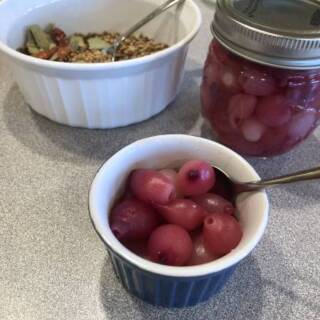
A dish of pickled onions sits with a jar of pickled onions.
This pickled pearl onions recipe is simple to make and yields tasty results every time. Try it out, you won’t be disappointed!

The depth of your water bath canner will determine how many jars you can do at one time, on two levels.

Let the water boil and then set the timer for 15 minutes. Once done, remove the canning lid and use your jar lifter to carefully remove the hot jars.

Set the jars on the counter (put a thick towel down first) and be sure to leave space between each jar. Now leave the jars alone for 24 hours to seal and cool down. As they jars seal, they will make a pinging noise.

After the 24 hours, test each jar to ensure it is sealed. Are all the seals concave? If not, put the jar in the fridge and plan to use it up first or you can again put them in the water bath to see if they will seal.


FAQs

How to Store Pickled Pearl Onions

If you don’t want to bother water bath canning any jars of pickles, you can easily reduce the recipe to make fewer jars. Then, after the jars have been filled with the pickling mixture, wipe the rims and place the seals and lids on the jars.

Let them cool on the counter for at least 12 hours (24 is better) and then just store the jars in your fridge. They will last indefinitely in the fridge because of the pickling.

Remember: If you do NOT can them, keep them in the fridge at all times.

If you do water bath can them, you can add these to your food storage, whether that is in your pantry or cold room. Because they have been through the canning process, they will be safe stored at room temperature.

How to Serve Pickled Pearl Onions

They’re a great appetizer, or use them in cocktails. Put a couple of pickled onions on a toothpick and serve with a martini with gin and vermouth. This is sometimes also called a Gibson cocktail. And pickled onions work as a great garnish for a Bloody Mary!

You can also add them to pulled pork, burgers, or other sandwiches, tacos and salads.

I recommend you drain off some of the liquid before serving, or you could combine it with a bit of oil and use it as a salad dressing.

Can you eat pickled pearl onions out of the jar?

Of course! If you love the flavor of these pickled pearl onions, feel free to grab a fork or toothpick and eat them right out of the jar.

Are pickled pearl onions good for you?

Pickled onions are known to have antioxidants, and ingredients that are anti-inflammatory and that can help with heart health and blood sugar levels!

What is a good substitute for pearl onions?

You can make this recipe using chopped white onions, shallots, or even leeks.

Do pearl onions have another name?

Pearl onions are also sometimes referred to as white cocktail onions, but are also called button onions, baby onions, or silverskin onions in certain places (like the UK).

A opened jar of pickled onions sits on a counter.
Pickled Onions is an easy canning recipe that is made in a water bath.

More Preserving Recipes

Our entire Country Living in a Cariboo Valley Recipe Collection can be found here, and here are some more fantastic canning and preserving recipes hand-picked for you!

  • Check here for an entire collection of preserving recipes.
  • This Pickled Asparagus is another great and easy pickling recipe!
  • And for something a little more festive, check out this recipe to learn how to can your own Homemade Salsa.


Homemade Pickled Pearl Onions Recipe

The Bottom Line: these Pickled Pearl Onions are easy to make and are a great way to fill your pantry

If you enjoy this recipe, please be sure to rate it 5 stars below! And print this off or save it to your recipes folder!

a dish of pearl onions and some pickling spice on the counter

Quick Pickled Pearl Onions Recipe

Yield: 4 pints
Prep Time: 30 minutes
Cook Time: 15 minutes
Total Time: 45 minutes

These quick and easy Pickled Onions are perfect for a condiment tray or used in cooking. Add to meat dishes, in tacos or in any tomato dish.

Ingredients

  • 8 cups peeled pearl onions (typically 10-12 oz)
  • 5 1/2 cups pickling vinegar
  • 1 cup water
  • 2 tsp salt (optional)
  • 2 cups sugar
  • 8 tsp pickling spice

Instructions

  1. Prepare jars for canning by washing them and then setting in a boiling water bath for 15 minutes to sterilize.
  2. Place canning seals in a shallow bowl; cover with hot water. Replace water as needed, if water cools too much.
  3. Put a large pot water on to boil.
  4. Prepare onions by removing loose wrappers. Then set in a colander and place into simmering water for 5 minutes.
  5. Plunge onions into cold water and then peel. Measure out 8 cups onion.
  6. Combine vinegar, water, salt and sugar and bring to a boil. Reduce to a simmer.
  7. Add spices to empty jars.
  8. Add pickles to the jars, put on the seal and canning ring (fingertip tight)
  9. Place jars in the water bath canner, bring to a boil and let boil for 15 minutes.
  10. Remove canning jars and place on the counter where they can stay for 24 hours without being moved.
Nutrition Information:
Yield: 16 Serving Size: 6
Amount Per Serving: Calories: 138Total Fat: 0gSaturated Fat: 0gTrans Fat: 0gUnsaturated Fat: 0gCholesterol: 0mgSodium: 294mgCarbohydrates: 34gFiber: 1gSugar: 29gProtein: 1g

Did you make this recipe?

Please leave a comment on the blog or share a photo on Pinterest

Category: Recipes

First Published October 2020; Updated October 2023


Filed Under: Canning, Recipes

4 Ways to Preserve and Store Food

By Annie

Food preservation isn’t just a skill; it is a way to really maximize your harvest, reduce waste, and preserve the flavors of the season all year round. I share how to store your food properly so you can save money, time, and stress.

Whether you grow your own vegetables or take advantage of farmers markets, you need a way to preserve and store that food for several months. Here are 4 ways to preserve and store food.

Stocking up in September & October when the harvest is plentiful is a great way to do it. Prices are lower, and there are a lot of choice veggies available.

Below, I’ve linked up some of our best posts on preserving food. Take a look! From preserving herbs, pickling (using brine and vinegars), making kimchi from scratch, jerky, homemade sauces, soups, salsas, stews and more, all from your own garden.

(Want a complete list of all of our preserving articles? They’re right here)


Here are 4 ways to preserve and store food:


Harvested carrots and lovage


Storing some food is a great way to save money. Prices are definitely going to be higher all winter long because of the lower local supply and the same high demand.

Starting your own food stockpile is a way to save money and feel more in control of your personal food supply.

Plus, preserving food is a fantastic way to reduce food spoilage if you are looking for a lower footprint. Plus, you can maximize long-term storage on items and reduce grocery store trips.

Read on for some popular methods of home food preservation.


A basket of fresh garden greens sits on a kitchen counter


Freezing Food

You can freeze some veggies. Every summer, I freeze a one-year supply of shelled green peas. And why not? Canning recipes is a great way to add shelf life to all that summer produce you worked hard on all summer. 

They taste fresh all winter long and don’t take long to make. You can even use fresh fruit like pears and apples to make jams and more in jars to keep on hand in your pantry. 

Plus, it’s guaranteed rocking time in the late afternoons – someone has to shell all the peas! Having self-sufficiency tools for preserving your goods is going to be a game-changer.

Other food items that works best for freezing include:

  • poultry
  • seafood
  • meat

 Use good quality freezer bags and ensure you close them air tight to keep out moisture and stop any growth of microorganisms.


Canned carrots and pickled beets on a counter


Canning Food

You can home can some veggies. Want to water bath can some Pickled Beets? How about pressure canning some Green Beans?

Water bath canning is the most usual way to preserve fruit like cherries, peaches and other stone fruits.

You can also water bath can a variety of juices too.

Home canning food can completely fill your pantry – you can literally save thousands of dollars a year by canning extra food. Aim for airtight containers, mason jars, and more that will help truly create that seal you need when it comes to canning jellies, berries, beef, and more.

They taste fresh all winter long and don’t take long to make. You can even use fresh fruit like pears and apples to make jams and more in jars to keep on hand in your pantry.

Now you can can the old-school way with pots of boiling water, or invest in a pressure canner. Either way, you have choices of food preservation methods that work best for you.

I love using the fermentation process for cabbage to make sauerkraut and other items to keep in your pantry. It adds so much flavor.

You can do this with pickling carrots, tomatoes, and other vegetables as well. Helps veggies last in the fridge or pantry for much longer without reducing their nutritional value.


Fresh kale trimmed and washed on a cutting board


Dehydrating Food

You could dehydrate lots of different types of fruits, vegetables and even meat. Dehydrated food takes up a lot less room.

Herbs, of course, are often dehydrated. We dry herbs and some spices every year, including:

  • mint
  • basil
  • lovage
  • oregano

That means extra freezer room for you to stock up on meat when it’s on sale.

You can also dehydrate foods you pick up on sale or grow, such as:

  • bananas
  • peppers
  • cucumbers
  • kale (make these healthy kale chips!)
  • turn ripe fruit into fruit leather


basket of fresh garden produce ready for preserving

Storing Food in a Cold Room

You could store a few boxes of root vegetables down in the cool part of your basement. These need to be in a cooler area in your home to preserve and extend the life and prevent bacteria, botulism, mold, and more from showing up on your food.

Vegetables that store well in a cold room are:

  • potatoes
  • onions
  • carrots
  • garlic

Squashes including:

  • pumpkins
  • acorn squash
  • hubbarb squash
  • all other winter squash

Note: Zucchini can be stored in a cold room, but use it up sooner rather than later. Winter squashes can be stored longer.

Storing Food When You Don’t Have a Basement

But what do you do if you live in a rancher home? If you have no basement,  you have to start looking at other option.

You could look at building a small insulated and vented room in a corner of your garage. Another option is to have a root cellar.

If you don’t have room for food storage inside your house, an outdoor root cellar is a great way to go. Built right into the ground, you can store all kinds of root vegetables inside  a root cellar.

Mother Earth News has several plans for outdoor cellars and they range from the super simple to structured cellars.

You need to live in an area where there are cold winters. You also need to put in some time digging and setting up the root cellar.

You do not want the cans at room temperature; they need to be in a cooler area in your home to preserve and extend the life and prevent botulism, mold, and more from showing up on your food.


Use Old Freezers to Store Livestock Feed


I have seen pictures of outdoor root cellars but instead of being boxed in with wood, the builder instead drops an old deep freeze in the ground.

This is a great idea and would really work well. We use old freezers here down at the barn to hold animal feed.

We don’t care if the freezers work or not. And we are keeping a few old freezers out of the landfill. Come to think of it, that’s where we got the three we have. A great way to recycle!


fresh produce at a market


Want to see all of our food preservation posts? Head right over!

Originally posted June 2020; latest update March 2026

Filed Under: Canning, Dehydrating Vegetables and Fruit, Food

Preserving Food: Freezing, Canning, and Pickling Food

By Annie

Want to be able to stock up food for emergencies? Have a garden and want to know what to do when you have a surplus harvest?

Or maybe you just want to know how to stretch your food and reduce food waste. Either way, preserving food could be the solution you’re looking for. Check out this post for some great tips on home food preservation.

Preserving Food: What You Need to Know About Freezing, Canning, and Pickling Food

What Does it Mean to Preserve Food?

Preserving food is, to put it simply, a way to keep your food lasting longer – without spoiling.

You accomplish this by using a variety of methods to essentially stop, slow down, or otherwise control the rate at which the food spoils.

Preserving recipes include home canned food.
There are so many foods that you can preserve to have delicious ingredients to use throughout the year!

But that’s not all! You also have to follow measures to make sure the food is safe to eat according to the National Center for Home Food Preservation (i.e. you won’t get food poisoning or, in extreme cases, even botulism).

Lastly, you would ideally preserve it in a way that retains as much of the flavor and nutritional value as possible. 

In other words, food preservation is the act of making food last longer while still tasting good and being good for you!

What Are the Benefits of Preserving Food?

Stretch Your Food Longer

As I mentioned above, the primary goal of food preservation is making your food last longer. Which means you get more bang for your proverbial buck.

Whether you spent money on food at the grocery store or put in work growing it in your own garden, I think we would all prefer to get the most out of our food.

Preserving your food is a great way to do that! You may not always be able to eat your food in a short period of time, so preserving it makes it readily available for when you can eat it. 

Preserving recipes including jars of canned carrots and tomatoes
You’ll quickly become a pro home food preserver with these handy tips.

Stretch Your Budget

It’s simple math: stretching your food means you’re also stretching your budget. That’s always a good thing, right?

We’ve been doing this for quite some time, so a lot of the time, we do our “grocery shopping” from our supply of preserved food.

Curious about how that works? Check out this article I wrote on how I shop for groceries without having to leave our home.

Obviously, you may not be able to do this (or even want to), but I believe that every dollar saved matters!


Avoid Artificial Preservatives

When you take the time to preserve your food at home, you’re actually doing your family a favor.

By preserving food yourself, you’re able to avoid the artificial preservatives that you usually find in commercially-processed foods. That, my friend, is a huge benefit!

fresh picked beans in a basket
Trimming beans before pressure canning in mason jars.

Food for Emergencies

What do natural disasters, viral outbreaks, and economic upheavals all have in common? They often result in people not having access to the things we need to survive.

Food is the top thing on that list. 

Whenever we know that a natural disaster is about to strike, the main priority most of us have is getting to the grocery store to load up on food and water.

If you start preserving food at home, when things like this happen, you won’t have to worry as much as other people. 

In the words of the Boy Scouts of America: “Be Prepared” (By the way, you should check out my article on Winter Pantry Essentials).


Enjoy Your Favorite Foods Out-of-Season

It’s a fact of life that different fruits and veggies are in their prime at different times of year. So, sometimes, you really want your favorite, but it’s out of season.

Your options are to either wait until they’re in season or to pay extra because it’s more expensive when it has to be shipped from some other part of the world. 

What if you didn’t have to wait, though? What if , when you’re craving that food, you can simply head to your pantry and whip out a jar of it? That’s what preserving food can do for you!


Food Preservation is Good for the Environment

Another benefit of food preservation is that it can help you reduce the amount of food that you throw away.

Reusing jars and bottles that would have otherwise ended up in a landfill is also helpful for the environment. 

jars of home canned food in pantry
Preserved jars of pickled beets, apple sauce and jelly wait to be added to the food pantry.

Unique Gifts

Ok, so this isn’t really a top priority benefit, but it’s still worth mentioning that people really appreciate thoughtful gifts. They also generally love food

Preserving food can be a great way to give your loved ones gifts that check both boxes. A cute and tasty jar of homemade jam could be the perfect gift for someone with a sweet tooth

And for the pickle lovers, you could give them a variety pack of pickled veggies for them to snack on. Plus, you save money on the gift. It’s a win all around!


What Are the Best Methods for Preserving Food?

When it comes to food preservation methods, there are definitely several viable options. Let’s talk about my three favorite methods.

Freezing Food

Freezing veggies is probably the easiest and most accessible method of the three simply because almost everyone already has a freezer in their home.

You don’t really need many materials other than some quality plastic freezer bags (for storage) and a marker or label maker (for keeping track of when they were initially placed in the freezer).

bags on frozen peas in the freezer
Blanched and frozen garden peas are bagged and added to the deep freezer.

Every single year, I blanch and freeze garden peas – and so can you! Here is an article that can walk you through the process, step-by step. 

And here’s how I freeze leafy greens – spinach, chard, kale, beet greens – they can all be frozen and preserved this way.

This works great for preparing smoothie greens for the coming week.

Veggies aren’t the only things you can freeze, though! I also freeze fruit all the time (which makes it easy for me to whip up a batch of my no-cook strawberry jam).

Freeze drying herbs is a great way to keep them fresh. I love being able to make basil pesto, so I sometimes freeze basil to have on hand.

I juice up fresh lemons and grapefruits and then freeze citrus juice in jars.

And, of course, you can freeze meat like chicken, fish/seafood, beef, pork, lamb, goat, etc. Try freezing soups and stews to have throughout the year!


Hey, if you ever need to defrost a chicken quickly (like for dinner) here’s how!

All about preserving food, canning, freezing, pickling and food storage
Make your food work for you and reap the benefits of home preservation!

Canning Food

When done properly (and with the proper tools, which typically involve cans and jars with a proper lid), canning is great at preventing decay for a long period of time.

In fact, a lot of canned foods will easily last for years. I’m writing this in early 2020 and last week we opened a home canned jar of Salsa from 2009!

Delicious! And when you’re like us and grow your own food, it’s really convenient.

After all, there’s only so much room you have in your freezer, but you can almost always find somewhere to stick a few (or several) cans of food. 

When it comes to canning, there are two different methods I recommend. 


Water Bath Canning

This method uses hot water and is reserved for high-acid foods. That means things like jams, jellies, fruit preserves, and pickles.

Water bath canning creates a vacuum seal that prevents the food from being exposed to air or other entities that can lead to spoiling or mold growth.

It’s NOT recommended for non-acidic foods (so, no meat/meat stock, non-acidic veggies/veggie stock, fish/seafood, or poultry).

Here are some water canning recipes I’d love for you to try out!

Water Bath Canning Asian Pears

Pears can make a great fruit sauce, pear cobbler, pear crumble, or just a sweet snack. You can also use this method for other fruits like peaches or apricots.

Homemade Canned Salsa

Here are so many things you can do with a nice batch of salsa! And the longer it marinates, the better it tastes!

newly canned jars of cherries preserved in the pantry
A jar of home canned cherries is a real treat to open in January.

Water Bath Canning Cherries

These cherries will be perfect for all kinds of baked goodies – including cherry pie, cherry turnovers, and cherry poptarts.

Homemade Tomato Sauce

From pasta to pizza and so many things in between, so many of my favorite recipes call for tomato sauce.

Having some on hand that I know tastes good is one of those small things that makes me happy.

Homemade Sauerkraut

I know it’s not for everyone, but Graham loves a heaping of sauerkraut every now and then. Plus, it’s a great source of probiotics (healthy bacteria).

Dandelion Jelly

Jelly is made in a water bath canner as well. Each Spring I make a few jars of Dandelion Jelly, which is wonderful on crackers with a bit of cream cheese.

Jalapeno Plum Jelly

Spicy and delicious as a spread, this jelly is made with Jalapeno peppers, red and green sweet peppers and lots of fresh plums.


Pressure Canning

When it comes to canning all those non-acidic or low-acid foods, you should always go with pressure canning.

That includes meats, poultry, fish/seafood, and most veggies. Root vegetables are typically good candidates. It’s essential that you use this method to properly and safely can these foods.

Below are some articles on pressure canning that you should check out. 

Using a Pressure Canner 

Start here! It will show you how to SAFELY can foods using a pressure canner. 

Jarred salmon ready to preserve using pressure canning.
Preserved jars of fresh fish is a great way to save money on meat during the winter.

Canning Salmon

Perfect for salmon burgers, salmon patties, salmon fried rice, and even salmon caesar salad!

Canned Green Beans

Green beans are one of those veggies just you just can’t go wrong with! 


Drying and Dehydrating

We do a lot of drying every year here, mostly we dry herbs. Here’s where you can find everything you need to know about drying herbs to use all year.

How to Harvest and Dry Parsley – easy to do and it lasts for months.

How to Dehydrate Apple slices – a great way to preserve apples.

How to Dry Lovage Herb – tastes like celery!

How to Harvest, Dry and Use Stevia – a more natural sugar replacement.

A General Guide to Drying Herbs – more general information.


Pickling Food

Pickling is another fantastic food preservation method you can use to preserve food for up to 2 years. 

One of the benefits of pickled foods that the other methods don’t offer is that it offers a unique flavor profile.

That makes it easy for you to add a little bit of zing to meals and snacks. Plus, fermented foods (like kimchi, which is made from cabbage) can often be a fantastic source of nutrients and probiotics.

Most pickled foods are simple to make and require only a few ingredients like vinegar, pickling salt, spices and herbs.

pickled eggs in a jar to preserve
You can preserve eggs by pickling them and keeping in the refrigerator.

Pickled Eggs

This is a favorite for so many! The health benefits of eggs combined with the big flavor of pickle juice is such a winner. And it makes for fantastic egg salad!

Pickled Garlic Scapes

My family has a garlic farm, so we always have lots of garlic scapes on hand in late June! Pickling them is our go-to.

Sauerkraut

In addition to canning sauerkraut, you can also pickle it. Makes a super fast dinner along with sausage and cole slaw.

Pickled Asparagus

Asparagus is a delicious early spring treat in the north. Have extra or find a great Asparagus sale on at the store?

Then pickle some Asparagus and enjoy in a Caesar or Bloody Mary. Add spears to your pickle tray; wrap some ham around Asparagus spears for an appetizer.

Pickled Fiddleheads

In early Spring, when the fern fronds are growing, you can pick them tightly coiled and make your own homemade Pickled Fiddleheads. This recipe makes two jars full, and you can store them in the fridge for months. Or water bath them so you can leave them on your pantry shelf safely.

Pickled Brussels Sprouts

Try something new and pickle some Brussels Sprouts. Take a look at the recipe; you can store a couple of jars in the fridge or water bath can them.

Easy Pickled Beets

Small beets are the best for pickling; slice larger beets before adding to the jars. Using whole small beets is a great way to thin out the beets in you garden.

And they always have to be thinned, because beets actually grow in a cluster from one seed.


What Else Can I Pickle?

There are a number of great foods that work for pickling, some you may not have thought of. Carrots, apples, potatoes, cauliflower, onions, and even pumpkin are all great options to preserve by pickling!

When it comes to storing your jars of food, there are certain things you do need to keep in mind. Find out more about storing home canned food here.

I hope that this helps you to stretch your food and your budget while providing your family with plenty of food to get you through the year. If you have any questions about preserving food, feel free to leave a comment for me below!

Preserving Food


various vegetables and herbs being preserved for pantry storage

Filed Under: Canning

  • « Previous Page
  • 1
  • 2
  • 3
  • 4
  • …
  • 6
  • Next Page »

Connect With Us!

  • Email
  • Facebook
  • Instagram
  • Pinterest
  • Twitter

Search this site

Generic selectors
Exact matches only
Search in title
Search in content
Post Type Selectors
Search in posts
Search in pages

Our Most Popular Posts

Garlic cloves in oil

How to Preserve Garlic in Oil – and Other Ways to Store Garlic

a open jar of pickled brussel sprouts on a counter

Easy Pickled Brussels Sprouts Recipe (Water Bath Canning)

Privacy Policy

Read about our Privacy Policy

Disclosure

Please note that some of this site’s links are affiliate links, and CountryLivinginaCaribooValley.com is a participant in the Amazon Services LLC Associates Program, an affiliate advertising program designed to provide a means for us to earn fees by linking to Amazon.com and affiliated sites. At NO ADDITIONAL COST TO YOU, I will earn a small commission, if you purchase them. I recommend them as they are good products.

Theme Design By Studio Mommy · Copyright © 2026