Country Living in a Cariboo Valley

Homesteading in BC

  • How to Get Started
  • Vegetable Gardening
  • Preserving Food
  • Recipes
  • Homemade Wine Recipes
  • About Us
  • Work With Me
  • Shop
    • Vegetable Garden Planner Printable: Grow Your Best Garden Ever
    • Grow Enough Food for a Year
    • Delicious Dandelions: A Recipe Collection
    • Dirt to Dollars: Selling at the Farmers Market
    • 8 Pounds in 8 Weeks: Raising Chicks for the Dinner Table
    • Making Wild Wine
    • Build a Hanging Chicken Feeder
    • 15 Things to Know About Living in the Country

Canning Salmon at Home

By Annie

Once you learn how to can salmon, you can pressure can many kinds of fish!

We have always loved to go fishing and years ago, we had to learn how to can salmon because there was only so much room in our freezer. And once we learned how to can fish, we started doing it every year!

This weekend, we canned most of the Salmon we had in the freezer, leaving only 4 bags with filleted fish to eat with meals.

Canning Salmon is not hard, but you definitely need to use a Pressure Canner. Here’s how we can Salmon and enjoy eating it all year around.

You can use this same canned salmon recipe for any type of fish such as tuna or trout. If you haven’t used a pressure canner before, read this, as it will explain exactly how to use a pressure canner.

First in learning how to can salmon is to pack the salmon in jars
Pack salmon tightly in half pint jars.

How to Can Salmon

The only ingredients needed are the fish, 1/2 teaspoon of coarse salt and 1 teaspoon of lemon juice per jar. We like to use these half pint wide mouth mason canning jars. It is much easier to get the fish out of a wide mouth jar as opposed to a regular jar!

Also, because there are two of us here, we can use the whole jar up in one use. If you have a family of four, you may want to use pint jars instead.

We thawed the frozen fish overnight and then made sure to rinse each piece well, under cold water. You can prepare the fish at room temperature or cold right out of the fridge.

Graham then used his fillet knife to cut the salmon flesh off the skin. He cuts as close to the skin as possible, essentially skinning each piece of fish. It’s sometimes easiest to do this with the fish skin side down. Then, the fish pieces get laid onto a plate lined with paper towel.

You may also need to remove bones, depending on what cut of salmon you’re working with. The backbone is particularly common to find and will need to be cut out.
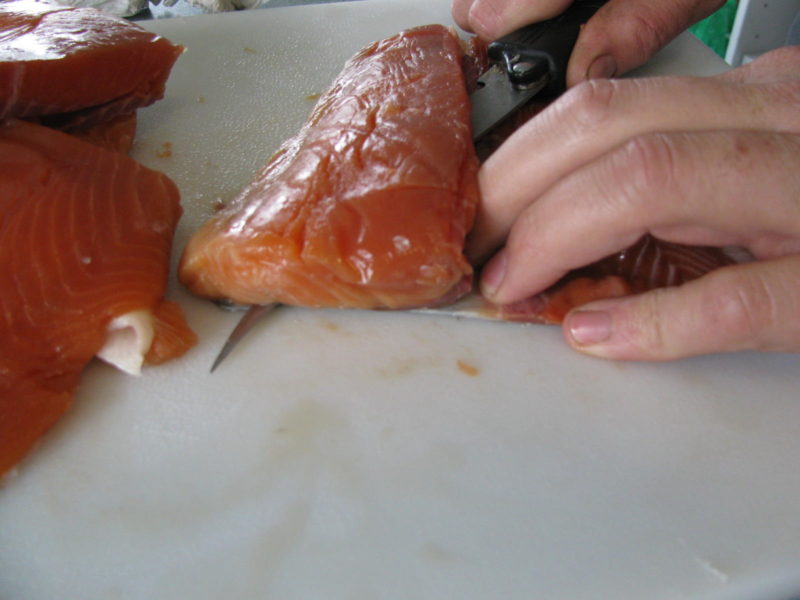
Skinning the salmon meat away from the skin.
Use a sharp knife to skin salmon before canning.

Getting Jars Ready for Pressure Canning Fish

Meanwhile, I got all the canning equipment organized that we would need. I washed 24 half pint jars.

If you are pressure canning, you don’t need to sterilize the jars, like you do when you water bath can.

How to can fish at home. Step by step process of canning fish to preserve it. Here's the recipe for canning salmon, trout and other fish. #recipe #canning #pressurecanning #homecanning #food #meals
It will surprise you how simple it is to can salmon at home!

The canning jars however do need to be clean and I always wash them out in soapy water before reusing them. I set the canning lids to soak in hot water and set all the lid rings aside.

Here are the jars all cleaned and ready for fish. Graham cut each piece of fish into smaller ones that will fit in the small jars. 

We like to place the first pieces of fish in the jar so that they are along the sides, then start to pack layers of fish in the middle of the jar. Make sure the pieces are not so long that they can interfere with the seals. You’ll want about a 1-inch headspace to prevent issues.

Salt sprinkled on top of salmon in canning jars.
Sprinkle salt into each filled canning jar. Be sure to wipe down the top for a clean jar rim, which will lead to a more secure seal.

Once filled, I added 1/2 teaspoon of coarse salt and 1 teaspoon of lemon juice to each canning jar.

Clean rims of each jar after they are filled. Then I put on the seals, which have been soaking in hot water and finally, adding screw on a ring over each seal and make sure the canner lids are on tight.


Instructions for Pressure Canning Salmon

  1. When we have enough jars filled, we add four quarts of water to the pressure canner and then we put a layer of jars inside. Room temperature water works just fine.
  2. Since we have a pressure canner rack to separate levels of jars, we put that in and have two levels of jars. This way, we were able to process 14 jars at a time.
  3. If you want to process a lot of jars at once, you need to use a second rack to keep the tops of the jars from hitting the bottom of the others.

    can fish, salmon, tuna, pressure canner
    Canning salmon is a great way to enjoy it as good as fresh through the entire year!
  4. Close the canner and turn up the heat on the stove. Once it starts steaming, we time it to vent for 10 minutes.
  5. After the venting time is over, we add the weight (15 lbs of pressure, because of our elevation) and then wait for the canner to again start steaming.
  6. Be aware that the higher the altitude, the more weight you’ll need to add. Times and weights may also vary a bit depending on the type of pressure canner you own.
  7. Once the ball weight starts to jiggle and let out steam, we can slowly start to turn down the heat under the pressure canner.
  8. Set the timer for 90 minutes and let the canner do its thing. It will continue to jiggle and build up pressure and then release it. That’s normal! Here is everything you need to know about using a pressure canner.


Home can your own fish! Use a pressure canner to safely can salmon and other fish. Step by step instructions to preserve your catch! #canning #pressurecanning #homecanning
This method also works with fish like mackerel and tuna.

What to do after your Pressure Canner is Finished

After 90 minutes, I turned off the stove and let the pressure canner sit there to start cooling down. This takes awhile, but it’s really important to not open the canner too soon.

Once it cooled down, I removed all the jars and set them off to the side where they can sit undisturbed for 24 hours. By then, I can give the jars a good wipe with a clean wet cloth and store the jars in the pantry.

In the end, we ended up with 22 half pints of salmon. We’ll enjoy this all Winter long!


How to Use This Canned Salmon Recipe

  • We’ll use this fish on sandwiches, on cooked pasta with a cream sauce or on top of a fresh garden salad.
  • Make a salmon salad and take advantage of all of the healthy proteins of this fatty fish.
  • Smoking salmon is also a great way to enjoy it and add some flavor before canning. The smoke process doesn’t need to get the salmon to a certain temperature when canning; it’s mostly to get the texture and smoky flavor. This guide has more information on smoking and canning salmon.


Guides for Canning at Home

  • How to Home Can Cherries
  • Here’s how to Make your own Salsa – and Can it too!
  • How to Make and Can Sauerkraut
  • Does the thought of pressure canning scare you? Here’s everything you need to know about How to Use a Pressure Canner to home can.


Originally published June 2019; Updated September 2024

Filed Under: Canning

How to Can Asian Pears

By Annie

Looking for instructions on How to Can Asian Pears? This post is a great place to start if you’re looking for tips on home food preservation!

Once when I was in the grocery store, they were having an awesome sale on Asian Pears. So good of a sale, I just couldn’t pass them up. I had never even heard of Asian Pears, but I knew Graham likes pears so thought I would pick some up and can them so we can use them over Winter.

A bunch of Asian pears on a kitchen towel.
Asian pears (or apple pears) are great to preserve in a boiling water canner.

Asian Pears are a cross between an apple and a pear. They have the shape of a large apple – this variety did. There are apparently about 10 varieties of Asian Pears.

They’re known for their crisp and apple-like texture, with a sweet and floral flavor.

The structure of these fruits makes them great for canning long-term! Here’s some crucial information on how to can Asian pears. If you can’t find them, this recipe also works for varieties like Bartlett, Anjou, or Bosc pears.

Preserve pears by canning them. Then add to the pantry to enjoy all year around. How to can pears and other fruits. #canning #preserving #food #recipe
This guide will teach you everything you need to know about how to can Asian pears!

How to Can Pears

  1. This recipe is simple and easy to follow! Get out the water bath canner, fill it with water and put 9 clean jars in there to be sterilized. Leave the jars in for 10 minutes AFTER the water begins to boil.
  2. Remove the peel and slice the pears, then place the sliced fruit in a large bowl. Add 1 teaspoon of Vitamin C for each gallon of water to prevent the fruit from browning. This ascorbic acid will help the pears keep their nice light colour.

    A bowl of sliced Asian pears.
    These crispy and sweet fruits are perfect to soak in a light syrup and preserve for as long as you need them!
  3. Add lemon juice to each pint jar. Asian pears are a low acid fruit, so you’ll need to add acidity for safe canning.

    Adding lemon juice to pint jars.
    Aside from the lemon juice, there’s not a preservative in sight!
  4. Make a light syrup on the stove by mixing 1 1/2 cups of sugar in 5 3/4 cups of plain water. Heat this and then drain the Asian Pears from the Vitamin C solution. Carefully add them to the canning liquid. (Instead of the syrup, you can also can in white grape juice, apple juice, or regular water).
  5. Heat them through and then you can add the hot fruit to your jars (this is called Hot Packing).

    Several open jars of pears ready to be hot water canned.
    Be sure not to overpack the jars for best results.
  6. Add the slices and syrup to each of the jars and wipe rims of the jars. Leave about 1/2-inch headspace in the jars.


How to Use Tattler Seals and Lids

  1. Meanwhile, I had put my Tattler reusable canning lids and seals in hot hot water and left them in there for about 10 minutes.

    Boiling lids and jar rim seals.
    It’s important to sanitize your canning materials in a large pot of boiling water to kill any bacteria.
  2. Put the Tattler sealing ring around the lid as shown in the picture. Place on top of each jar.
  3. Now screw the canning jar band on. Make sure to leave the band slightly loose on the jar. You do NOT over tighten Tattler lids before processing – that comes after you remove them from the water bath.

    Adding tattler lids to prepared jars of pears.
    I love using Tattler lids for home canning–they’re easy to work with and reusable!
  4. Now put them into a boiling hot water bath canner and leave them be for 20 minutes. Remove them using canning tongs and set them on a towel on the counter. Keep the jars out of any drafts and leave them there for 24 hours. After that you can wipe the jars down and store in your pantry.
A close up of canned Asian pears.
If you have pounds of pears that you don’t know what to do with, this is an excellent option to extend their shelf life.

The finished product, after being in the water bath for 20 minutes. As soon as I took them out, I tightened the bands. This is the way the Tattler lids work.

8 jars of canned Asian pears.
Easily and safely preserve your own fruit at home by learning how to can Asian pears!

It’s different from the usual seals and lids, but Tattler is unusual! Why? Because you can reuse and reuse and reuse these rings and lids over many years. If you’ve never tried Tattler lids and seals, give them a try.


Altitude Adjustments

Keep your altitude in mind when canning–the higher you are, the longer you’ll have to process your pears. The processing time also differs depending on whether you’re packing in a pint jar or a quart jar. (This is important to keep in mind to prevent botulism and other bacteria and to preserve your fruit safely.)

  • 0-1,000 ft: 20 minutes (25 for quarts)
  • 1,001-3,000 ft: 25 minutes (30 for quarts)
  • 3,001-6,000 ft: 30 minutes (35 for quarts)
  • Over 6,000 ft: 35 minutes (40 for quarts)


More Canning Recipes

  • We do a lot of canning here every year – here’s how to can cherries.
  • Every fall, I make Graham a couple of batches of sauerkraut, then can that up as well. Here’s how we make our own Sauerkraut and how to can Sauerkraut.
  • Got canning questions? Head here to find out general canning guidelines.
How to water bath can pears and other fruits. Water bath can up some jars then add to your pantry. #canning #preserving #waterbathcanning #food #pantry
This is a great way to preserve pears by the bushel, whether it’s for your own pantry or gifts for friends and family!


Jars of processed pears getting lids added before canning.

How to Can Asian Pears

Yield: 8 pints canned pears
Prep Time: 30 minutes
Cook Time: 20 minutes
Total Time: 50 minutes

Learn how to can pears using a water bath, then enjoy this delicious canned fruit any time of the year!

Ingredients

  • 6 large Asian pears
  • Vitamin C (ascorbic acid)
  • Lemon juice

Instructions

  1. Get out the water bath canner, fill it with water and put 9 clean jars in there to be sterilized. Leave the jars in for 10 minutes AFTER the water begins to boil.
  1. Remove the peel and slice the pears, then place the sliced fruit in a large bowl. Add 1 teaspoon of Vitamin C for each gallon of water to prevent the fruit from browning.
  2. Add lemon juice to each pint jar.
  3. Make a light syrup on the stove by mixing 1 1/2 cups of sugar in 5 3/4 cups of plain water. Heat the syrup.
  4. Drain the Asian Pears from the Vitamin C solution. 
  5. Carefully add them to the canning liquid.
  6. Heat the pears, then add the hot fruit to your jars.
  7. Add syrup to each of the jars and wipe the rims of the jars. Leave about 1/2-inch headspace in the jars.
  8. Put them into a boiling hot water bath canner and process for 20 minutes. 
  9. Remove them using canning tongs and set them on a towel on the counter. 
  10. Keep the jars out of any drafts and leave them there for 24 hours. 
  11. After that you can wipe the jars down and store jars in your pantry.
Nutrition Information:
Yield: 16 Serving Size: 1
Amount Per Serving: Calories: 19Total Fat: 0gSaturated Fat: 0gTrans Fat: 0gUnsaturated Fat: 0gCholesterol: 0mgSodium: 0mgCarbohydrates: 5gFiber: 2gSugar: 3gProtein: 0g

Did you make this recipe?

Please leave a comment on the blog or share a photo on Pinterest

© Annie
Cuisine: American / Category: Recipes


Filed Under: Canning

How to Make Tomato Sauce from Fresh Tomatoes

By Annie

Follow this easy guide to make tomato sauce from fresh tomatoes!

We love tomato sauce and use it a lot in cooking. If you family loves the flavors of tomato recipes, it is easy to make your own sauce. Bonus for you if you live in a climate where you can grow lots of garden tomatoes!

Tomato sauce simmering on stove in three pots.
Read more about how to make tomato sauce from fresh tomatoes.

Why You Should Try This Fresh Tomato Sauce Recipe

Here in the Cariboo, it is almost impossible to grow tomatoes outside. It cools down too much at night here for them, and the afternoons can be cookin’ hot – 35C is the norm here.

There is no way I have enough room in our greenhouse to grow the amount I need to make large batches of sauce. I do plant enough tomato plants so we could have some fresh in salads and on sandwiches.

Buying Tomatoes In Bulk

We usually take a late summer trip to Lillooet or Cache Creek and buy tomatoes in bulk. If I’m lucky and someone is coming for a visit, they stop by and load their car with several cases.

I often get 200 pounds at a time so I can make enough sauce to last us a few years. Buying in bulk makes the most sense to me to make tomato sauce from fresh tomatoes!

Buying in bulk works well for me – I can decide when I can set aside enough time to do the processing. It takes several days to get it all done, but I like to do them all at once. And it’s not hard work, it just takes some time.

Beefsteak tomatoes in boxes
Roma tomatoes make the best sauce. These beefsteak tomatoes will be good, just need to simmer longer.

A nice box full of juicy tomatoes, ready to get processed. These are beefsteak tomatoes; we love just slicing and eating them fresh. We also love BLT’s, especially when they are made with our own home smoked bacon and homegrown lettuce.

Roma tomatoes sit in boxes waiting to be sliced.
Roma tomatoes – nice and firm.

What Kind of Tomatoes Make the Best Sauce?

These are Roma tomatoes and they are best ones to use to make tomato sauce. Lots of flesh and I think they have fewer seeds. They aren’t as juicy as Beefstake or field tomatoes, so Romas would not take as long to cook down into sauce.

However, the market only had one box of Romas, so he made up the difference with field tomatoes. That’s OK, although it does take longer for the sauce to reduce down and get nice and thick.

Quartered tomatoes warming up on the stove


How to Make Homemade Tomato Sauce

When I make tomato sauce, I start by washing all the fruit in the sink or a large bowl. No need to bother with peeling the tomatoes, because my awesome food mill will take care of that. After rinsing a batch of tomatoes well, I use a knife to cut them into quarters and toss them in a large stock pot or sauce pot.

If the tomatoes are really large, I cut them even smaller since I want them to warm up and break apart as quickly as possible.

I put the stove burner on medium low or medium heat and just let the tomatoes warm up there while I quarter more tomatoes and get them going on another burner.

Tomatoes simmering slowly on the stove.
Let the tomatoes warm up and begin to break down

Once they have warmed up, I just use a potato masher to start squashing the fruits.


Make Tomato Sauce from Fresh Tomatoes

I don’t add any water at all to the saucepans, so I am careful to start mashing them pretty quickly, just to get some sauce going at the bottom of the pot.

After mashing, I leave them alone, usually until the tomatoes start simmering. This breaks them down quickly and they are ready for the next step.

In the picture above, you can see the mixture of skins, seeds and lots of liquid. This pot of tomatoes is ready to be put through the mill.

Simmering Tomatoes

Don’t be too quick to take your pots of tomatoes off the stove; let the stove heat the fruits so they become very soft. This can take anywhere from 15 minutes to 30 minutes, depending on the size of your tomatoes. Don’t try to hurry the cook time. Let the stove do the work and you will save yourself a lot of mashing.

It’s not uncommon for me to be using all four burners. I have 3 pots of tomatoes getting reduced and ready for the food mill. The last burner holds the actual sauce and I just keep adding to that stock pot as I mill more.

I can get a good rhythm going, between cutting and quartering, reducing, milling and sauce simmering. It’s like cut cut cut, stir, mash, stir, mill and then back to cutting. You will find you can get moving pretty quickly.

Boxes of tomatoes wait to be processed.
Romas and Beefsteak tomatoes – and lots of them!

And who wouldn’t want to speed up the work when you have this in your sights every time you turn around from the stove? 

Once the tomatoes have been lightly mashed and they are warmed right through, it’s time to run them through the food mill.

Tomato sauce being run through a food mill
This food mill works great to separate the seeds and skins from the juice.


Using a Food Mill to Make Homemade Pasta Sauce

Here is the food mill I use to make tomato sauce (and applesauce!) – it works great, isn’t expensive and it’s easy to clean. I’ve used it for years and it is still going strong.

I pour the tomatoes into the mill and start turning until it reaches my desired consistency. Since some of the tomatoes have already become juice while they were warming up, that juice just runs straight through the mill into the bowl or pot below.

I do not have to remove any core sections from the tomatoes when I quarter them, as this mill does a fantastic job of separating the juice from the seeds and skins.

Everything good goes into the pot below and all the waste stays in the mill. I do clean out the mill after every potful, but I don’t take it apart at all to do this.

I just use a large spoon and scoop up the waste and drop it into a large bucket. When the bucket is full, I can offload it to the chickens, who love it.

No chickens? No problem. Just add this waste to your compost pile – your garden will thank you the following year!

Tomato sauce simmering slowly on the stove
Simmer the tomato sauce slowly on the stove, reducing the liquid

Here’s what the sauce looks like when it comes through the food mill. Of course, it is still very runny, but that will change. What I like is that I end up with pots of sauce with absolutely no seeds or pieces of skin.

Simmering the Tomato Sauce

Once I have some sauce in the large pot, I turn that burner on medium low.

I will adjust it to high heat once I get more sauce added and the pot is fuller. The idea is to bring to a boil, and then let it simmer.

The simmering removes some of the water that is in the tomatoes and since we don’t want runny sauce, this pot will stay on the stove for awhile, sometimes 2 days. I don’t cover the pot, as I want the liquid to evaporate and the sauce to thicken.

I stir it often when I’m working in the kitchen and at night when I am ready for bed, I turn the burner down to low.

This lets the sauce keep reducing throughout the night and in the morning I can see a big difference in the quantity of sauce in the pot.

An important note: In the morning, I start stirring the sauce again, but I don’t stir all the way to the bottom of the pot. This is just in case there is a bit of scorched sauce on the bottom, from leaving it going all night.

Tomato sauce simmering on the stove
Homemade tomato sauce simmering slowly

This picture was taken later in the day. As you can see, I have been saucing more tomatoes. There are three pots of sauce going by this point.

So you see the sauce that sits on the sides of the stockpot? I scrape that every once in a while and stir it into the sauce. Using a rubber spatula works great for this. That is good stuff there, so make sure you use it!

Once the large pots have reduced some, I can add the contents of that third smaller pot, divvying it up between the 2 larger pots.

This frees up my pot so I can….yes, quarter more tomatoes and get more sauce going! In the morning, I start canning whichever pot of sauce has been simmering the longest.

I do not add any new sauce to these pots in the morning, as they are thickened and I don’t want to thin the sauce by adding more liquid.

jars of tomato sauce sit beside pots of homemade tomato sauce simmering on stove
Homemade tomato sauce recipe for canning. Learn how to make your own tomato sauce. Turn tomatoes into homemade tomato sauce and then preserve in jars to enjoy all year long.

I find that I can get a good rhythm going here too – I can the one pot of sauce and leave the other to simmer longer. Because I have one large pot emptied, I can ready more tomatoes and start adding it to that new pot.

Making your own tomato sauce is easy to do and I personally find it fun to spend a few days canning my heart out in the kitchen. Last year, I started making my own homemade HP sauce (it’s like A1 sauce) and water bath canned it, just like this tomato sauce is canned.

The absolute best thing about canning for me is when I can look at all those jars of food on our pantry shelves and know it is good wholesome, good for us food.

These tomatoes were grown with no chemicals added to the soil, and that’s what lets me know this food is healthy for us! If you can, try to find a market stand or farmer’s market where they advertise that they don’t use chemicals.

Your family and your body will thank you for being smart about what you are putting on the dinner table.

How to Freeze Tomato Sauce

For storage of fresh tomato sauce, my preference is to water bath can it in jars. However, you can easily store the sauce in the freezer. 

Just freeze your sauce in airtight containers (stackable would work best). Another alternative is to let the sauce cool completely, fill Ziplock bags and lay flat in the freezer. After they are frozen through, you can stack the bags.

Whenever you need some, just take a bag out and let it thaw in the fridge.

Homemade Tomato Sauce Variations

  • Add additional ingredients for flavor. Onions and garlic are a classic choice, but you can also add things like fresh basil leaves, red pepper flakes, celery, carrots, or extra virgin olive oil.
  • Season with salt and pepper to taste, and throw in additional seasonings like oregano, parsley, or other fresh herbs.
  • If you want to add meat to your spaghetti sauce, you can do so, but you’ll have to change the method to pressure canning in order for the sauce to be safe.
  • Roma tomatoes are often used to make sauce, but feel free to use other varieties like San Marzano, Plum Tomatoes, Viva Italia, or Amish Paste tomatoes. You’ll want to aim for tomatoes with a low water content and low seed content. In a pinch, even cherry tomatoes might work for a cherry tomato sauce.
  • This method works well as the base for pizza sauce, a homemade marinara sauce recipe, or homemade spaghetti sauce.
jars of pickled vegetables sit on a table
One of the best canning recipe books there is!


Safe Home Canning Information

If you are new to canning, you really should learn as much as you can about the process. I am able to water bath these jars of sauce, but ONLY because I add lemon juice to each jar.

You need to know these things before you start putting food by for your family. 

The Ball Complete Book of Home Preserving outlines the processes of both water canning and pressure canning.

They are two completely different things and you should have a good understanding of the process before you start.

Tomato sauce sits beside fresh tomatoes on a counter.
Save this to your Pinterest board!

Here’s an article all about How to Use a Pressure Canner.


Complete Canning Set
Everything you need to start water bath canning at home. Click to learn more

Water Bath Canning Kits

You will also need a set like the one above – it’s a complete set which includes everything you need to water bath can, except for the canning jars and seals. Click on the picture or the link to learn more.

I’ll cover the actual canning of the tomato sauce in another post. Don’t be afraid to start canning food – it is easy to do, you just need to know that you shouldn’t cut any corners.

Do it the safe way – the way it is supposed to be done. This way, there is no worry about whether the food in those jars is safe to eat.

If you are new to canning, turning tomatoes into sauce is a great way to get started! You could also make and can applesauce, which also follows a very easy process.

Make tomato sauce from fresh tomatoes this year! 


More Posts You’ll Love

  • If you like Salsa, check out how to make and can your own Salsa – it’s delicious!
  • Home canned foods last a long time, so feel comfortable putting up enough canning to last several years!
  • If you want to read my other canning posts, you will find them here.
  • If you have any questions, please just leave them in the comment section and I will answer them for you. Enjoy!


latest update October, 2022

Filed Under: Canning

The Prepper’s Canning Guide – Book Review

By Annie

Check out my Prepper’s Canning Guide review – then order your copy!

Daisy Luther has written four books and her latest is The Prepper’s Canning Guide. I just finished reading it and was happy to find some delicious recipes for all kinds of canned items.


Cover of Prepper's Canning Guide book.
You can order this book on Amazon. Just click on the picture.

Prepper’s Canning Guide – Book Review

However, it isn’t just a compilation of recipes – Daisy covers the procedures of canning (both water bath canning and pressure canning) as well as food safety guidelines. She explains how to use a canner as well as modern pressure canning methods.

She takes us through the process of canning vegetables and fruits, plus there is a section devoted to canning entire meals in one jar.


Prepper's Canning Guide includes recipes for canned stew.
Canned stew ready to go in the food pantry.

Meals in Jars

That photo above is some pressure canned Lamb stew we made a couple of years ago. So very easy to just pull a jar from the pantry, heat it up and serve with salad and a dinner bun!

We find meals in jar super helpful because we are always so busy these days! Instead of having to come up with new ideas for dinners on busy weeknights, we can just grab a jar or two, heat it and serve it up.

How easy is that? If we are really hungry at lunch, we can each grab a jar of stew. If we’re not, we’ll grab a jar of soup instead. Such a quick meal when we are in a hurry.


Cherries water bath canned and ready for the pantry.
Water bath canned cherries ready to put away.


The Prepper’s Canning Guide isn’t just for preppers, so don’t turn away from it because you think it is for survivalists or extreme thinkers. It’s an approachable guide to up the level of your emergency food supply!

So, give it a read and glean a LOT of information about how to can foods safely, what to do with all those garden harvests and how to fill your pantry with delicious healthy meals.

This book includes canning different types of meat. So,  if you find a great sale on beef at the store, grab it and start canning.

You can save a LOT of money buying things only on sale. Then preserve them and put them away. Buy in large quantities (bulk shopping), start preserving and be able to store nutrition-packed foods in your food storage.

Grab a jar at dinner time and you’ll be enjoying your money savings all year round.


A lady stands in a full root cellar full of canned vegetables and fruits.
Grandma’s root cellar was full for good reason.


Recipes in the Canning Guide:

(just a few of them, actually)


Cranberry Sauce

Sugar Baked Ham

Stock for Making Soups

Sweet & Sour Chicken

Chili Con Carne

Cajun Jambalaya

Boston Baked Beans

Spicy Apple Rings

Protein-rich meat dishes

all kinds of Pickles and Relishes

Lots of recipes for jams, jellies, stews, chicken and other poultry dishes and more.


Prepper's Canning Guide includes a recipe for canned green beans.
You’ll find recipes for canning green beans and lots of other vegetables.

Home Canning

If you are new to home canning, it’s important to know that you need to follow the specific process for what you are doing. Canning shelf-stable foods is not difficult, but it must be done properly.

So, up your level of preparedness and become more self-sufficient! Be prepared for power outages, runs of the food in grocery stores and medical emergencies. People’s desperation for food can result in bare shelves. 

Take care of your own food storage. By doing so, your family will be well-fed even in times of food scarcity.

Having a lifesaving supply of food is an important part of self sufficiency, and even at times, survival.

This book covers the information you need to know – you can also read articles here on this site for water bath canning and also pressure canning.


Canning pears using Tattler Lids and rings.
Tattler canning equipment features reusable lids and rings.


If you are using Tattler Reusable Lids and Seals, you can read my article here about water bath canning using Tattler lids. These lids have their own special instructions that need to be followed.

Why You Need this Book

The Prepper’s Canning Guide is available on Amazon. I promise you will find new recipes, tips and tricks for preserving, and everything you need to bring your preserving to the next level.

This book is like a cookbook from your grandmother – full of healthy safe food. It even includes grid failure canning tips and use time-tested water-bath methods. Check out the customer reviews!

You can find every one of the preserving recipes on Country Living right here!

Canning guidelines presented by governmental publications are here.

Also, if you want to read my review, check out this post on a great book full of Dehydrating Recipes!


Prepper's Canning Guide book cover
Order the Prepper’s Canning Guide on Amazon.


(NOTE:  There is a typo in the recipe for the Mexican – Texan Chili found on pg. 130. It should read “8 Tablespoons ground cumin” – I have verified this with the publisher.)


originally published Sept 2017; latest update December, 2022

Filed Under: Canning

Tattler Canning Lids – Important to Read

By Annie

I love using Tattler lids and seals. Instead of having to buy new canning seals every year, I can reuse the Tattler seals. There are people who have been using the SAME seals for over 20 years. Now that is impressive.

They are made in the USA so you can buy them knowing that you are supporting an American company. They are also BPA free, with FDA approved materials.


Tattler company banner with canned jars full of vegetables and words Tattler Reusable Canning Lids above.


Using Tattler lids and seals is a bit different than using those metal seals.

Even though the instructions state that you are supposed to screw the band on LOOSELY before processing, people have not been doing this. Apparently, they are over tightening the band.


Tattler Reusable Canning lids and seals last for years. They do work a bit differently. Here's how to use Tattler Canning Lids and Seals #canning #tattler #preserving


In light of this, Tattler has put out new instructions. If you are home canning your own food for your family, it is up to YOU to ensure you are doing everything correctly and “by the book”.

Would you home can food that has spoiled? No of course you wouldn’t!

 Would you just reuse dirty jars for a fresh load of canning? No of course you wouldn’t!

You do everything you can to ensure that your home canning is as safe as it can possibly be. There is no such thing as being “too anal” when it comes to canning.

Months after canning, when I go to open a jar of Asian Pears, I want there to be NO doubt that the food in that jar is safe to feed my family.


tattler, canning, canning fruit


So, when you are using the Tattler Lids & Seals, be sure to FOLLOW their instructions exactly.

Here’s the instructions – be sure you follow them!


tattler, canning, preserving, water bath canning, pressure canning


Tattler Reusable Canning Lids – Instructions for Use

1. Inspect top of jar for cracks and nicks.

2. Wash, rinse and sterilize jars. Scald lids and rubber rings. Leave in water until ready to use.

3. Fill jars as indicated per canning instructions for that food type.

4. Wipe top of jar after filling. Place lid and rubber ring combination on jar.

5. Screw band on jar loosely. Center lid on jar and hold in place with finger while tightening the metal screw band finger-tip tight.

DO NOT OVERTIGHTEN. Product must be allowed to vent during processing.


tattler, canning, food, preserving


6. Process as per instructions for various foods.

7. TIGHTEN METAL BAND FIRMLY IMMEDIATELY UPON REMOVAL FROM CANNER.

8. When jars have cooled, remove metal band and lift gently on the lid to determine if any failure has occurred. Sealed jars may be stored without metal bands if desired.

9. When removing lid, gently insert dull side of table knife (or similar object) between rubber and lid or jar to release the seal – DO NOT USE SHARP KNIFE.

10. Wash plastic lids and rubber rings, rinse, dry and store for future use. Do not save any rubber ring which is cut or deformed.


Want to read about how I canned pears using Tattler lids and seals?

Does the idea of pressure canning scare you? Read about how to use a pressure canner – then get started! Fill your pantry with jars of healthy homecanned food.


Are you using Tattler canning lids and seals properly? Not the same way you use metal seals. Here's how to use them properly. #canning #tattler #pressurecanning #preserving #food


Filed Under: Canning

  • « Previous Page
  • 1
  • 2
  • 3
  • 4
  • 5
  • 6
  • Next Page »

Connect With Us!

  • Email
  • Facebook
  • Instagram
  • Pinterest
  • Twitter

Search this site

Generic selectors
Exact matches only
Search in title
Search in content
Post Type Selectors
Search in posts
Search in pages

Our Most Popular Posts

Garlic cloves in oil

How to Preserve Garlic in Oil – and Other Ways to Store Garlic

a open jar of pickled brussel sprouts on a counter

Easy Pickled Brussels Sprouts Recipe (Water Bath Canning)

Privacy Policy

Read about our Privacy Policy

Disclosure

Please note that some of this site’s links are affiliate links, and CountryLivinginaCaribooValley.com is a participant in the Amazon Services LLC Associates Program, an affiliate advertising program designed to provide a means for us to earn fees by linking to Amazon.com and affiliated sites. At NO ADDITIONAL COST TO YOU, I will earn a small commission, if you purchase them. I recommend them as they are good products.

Theme Design By Studio Mommy · Copyright © 2026